

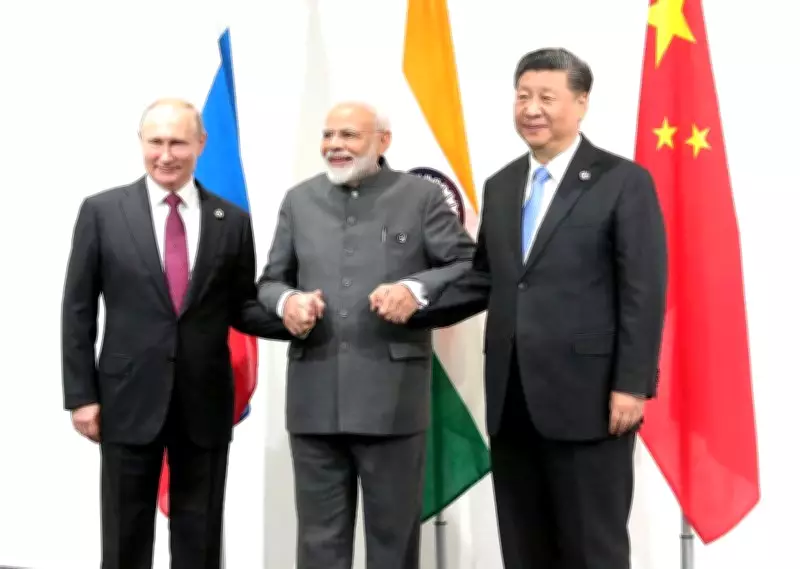
The global order is undergoing a tectonic shift, moving away from the unipolar dominance of the United States towards a new bipolar configuration. Two key groupings—BRICS and the Quad—are emblematic of this transition, representing competing poles of influence. While BRICS, led by China and Russia, seeks to challenge Western hegemony, the Quad, comprising the US, Japan, Australia, and India, aims to uphold a rules-based order in the Indo-Pacific.
The Rise of BRICS
BRICS—originally Brazil, Russia, India, China, and South Africa—has expanded its ambit with new members like Iran, Egypt, Ethiopia, and the UAE. This bloc represents a significant economic and demographic heft, accounting for over 40% of the world's population and a quarter of global GDP. The recent summit in Kazan, Russia, underscored its ambition to reform global governance institutions such as the UN Security Council and the IMF. China, as the bloc's economic powerhouse, is driving initiatives like the New Development Bank to offer alternatives to Western-led financial systems. However, internal divergences, particularly between China and India, limit its cohesion.
The Quad's Strategic Response
In contrast, the Quadrilateral Security Dialogue (Quad) focuses on maritime security, critical technologies, and infrastructure in the Indo-Pacific. Its recent summit in Delaware highlighted cooperation on vaccine production, climate action, and countering disinformation. The Quad's strength lies in its shared democratic values and strategic alignment, though it lacks the economic breadth of BRICS. India's participation in both groupings reflects its strategic autonomy, balancing economic ties with China and security partnerships with the West.

India's Balancing Act
India occupies a unique position as a member of both BRICS and the Quad. This dual membership allows New Delhi to engage with multiple poles while advancing its own interests. On one hand, BRICS offers a platform to push for reforms in multilateral institutions and enhance South-South cooperation. On the other, the Quad provides a framework to counter China's assertiveness and secure supply chains for critical technologies. India's stance is not about choosing sides but about shaping a multipolar world that accommodates its rise.
Implications for the Global Order
The emergence of these two blocs does not necessarily lead to a rigid bipolarity akin to the Cold War. Instead, it reflects a more fluid multipolarity where alignments shift based on issues. For instance, while India and China are rivals in the Quad context, they collaborate on BRICS platforms for financial reforms. Similarly, the US and Russia find common ground on arms control despite opposing blocs. The new bipolar world is thus characterized by competitive cooperation, where major powers engage in both rivalry and collaboration.
In conclusion, the BRICS and Quad represent the two poles of a reordering world. Their evolution will shape global governance, security, and economic norms. For India, navigating this landscape requires deft diplomacy to leverage opportunities from both groupings while mitigating risks. The outcome will determine whether the 21st century witnesses a stable multipolar order or a descent into great power competition.






