

China Masses Over 200 J-6 'Drones' Near Taiwan as US-Iran War Escalates
China has strategically positioned more than 200 converted J-6 fighter jets, now repurposed as attack drones, at multiple air bases close to the Taiwan Strait. This deployment, revealed through satellite imagery analysis by the Mitchell Institute for Aerospace Studies, marks a significant evolution in Beijing's military posture regarding Taiwan. The ageing J-6 aircraft, originally designed in the 1960s, have been modified into unmanned systems and are part of China's expanding drone arsenal, stationed across at least six bases in Fujian and Guangdong provinces.
Global Disruptions Reshape Strategic Timing
China's moves near Taiwan are unfolding against a backdrop of escalating global instability, particularly with conflicts in West Asia and maritime chokepoints straining the international order. Tensions in the Middle East, around the Strait of Hormuz and the Red Sea, have disrupted global energy flows and trade. Iran's actions to restrict access through the Strait of Hormuz have caused oil prices to soar, with nearly a fifth of the world's oil passing through this critical artery. Analysts warn that securing Hormuz is more complex than past operations in the Red Sea, where efforts to counter Houthi attacks proved costly and only partially effective.
Kuwait Petroleum CEO Sheikh Nawaf Saud Al-Sabah emphasized the global stakes, stating, "There is no substitute for the Strait of Hormuz." The Red Sea crisis serves as a cautionary precedent, as Western forces struggled to fully secure shipping lanes against drones and missiles. Experts note that Iran, with advanced military capabilities and favorable geography, presents an even greater challenge. This broader disruption matters for East Asia, as Western military focus stretches across multiple theatres, potentially creating opportunities for Beijing to factor into its evolving Taiwan strategy.

Turning Old Jets into New Weapons
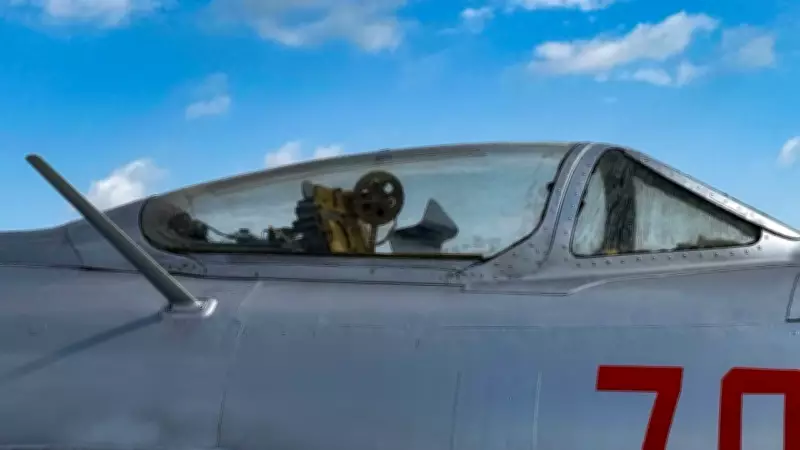
At the center of China's latest deployment is the transformation of obsolete J-6 fighters into expendable attack platforms. Derived from the Soviet-era MiG-19, the J-6 once formed the backbone of China's air force. Now retired from frontline service, hundreds of these aircraft have been converted into drones, designated J-6W. These systems are not typical remotely piloted drones but function more like cruise missiles, stripped of original equipment and fitted with automated flight control systems and terrain-following navigation.
Senior fellow J Michael Dahm estimates that over 500 such aircraft may have been converted, with a significant portion now positioned near Taiwan. Their role is straightforward: to overwhelm defences through sheer volume in saturation attacks. "They will attack Taiwan, U.S. or allied targets in large numbers, effectively overwhelming air defenses," Dahm said, adding that they are used more like cruise missiles than autonomous unmanned aerial vehicles.
The Logic of Saturation Warfare
The deployment reflects a broader shift toward saturation warfare, where China invests in large numbers of relatively inexpensive systems to strain and exhaust enemy defences. In a Taiwan scenario, these drones would likely be part of a multi-layered assault involving ballistic missiles, cruise missiles, advanced fighter jets, and modern unmanned systems. Peter Layton, a visiting fellow at Griffith University, described the potential scenario as overwhelming, stating, "There would be a lot of diverse things all coming at the same time. It would be an air defense nightmare."
The objective is not necessarily precision in the first wave but disruption. By forcing Taiwan and its allies to expend costly interceptor missiles on relatively cheap drones, China could degrade defensive capacity early in a conflict. A senior Taiwanese security official echoed this concern, noting that such drones are intended "to exhaust Taiwan's air defense systems in the first wave of an attack."

Cost Asymmetry and the Economics of War
One of the most significant aspects of this strategy is cost asymmetry. Modern air defence systems rely on expensive interceptor missiles, often costing millions of dollars per unit, while converted drones like the J-6W are far cheaper, repurposing existing airframes. This creates a dilemma for defenders: shooting down each incoming drone with high-end missiles is financially unsustainable, yet allowing even a few to get through could cause significant damage to critical infrastructure.
Taiwan's defence research bodies have warned, "This is a form of asymmetric warfare that cannot be ignored." The experience of the war in Ukraine and ongoing conflicts in the Middle East reinforces this lesson, showing that drones deployed in large numbers can overwhelm even sophisticated defence systems.
Why Taiwan Remains Central to Beijing's Strategy
Beijing considers Taiwan a breakaway province and has not ruled out the use of force to bring it under its control, while Taiwan rejects these claims, maintaining that its future should be decided by its people. The strategic importance of Taiwan extends beyond political symbolism; its location in the western Pacific makes it a key node in regional security architecture, particularly in relation to US alliances in Asia.
Control over Taiwan would significantly alter the balance of power in the region, giving China greater access to the Pacific and potentially constraining US military operations. Recent assessments offer mixed signals about Beijing's timeline, with some US intelligence estimates suggesting China is not currently planning an invasion by 2027, while Pentagon assessments indicate China aims to be capable of conducting and winning such a conflict within that timeframe.
A Layered and Evolving Airpower Mix
The J-6 drones are only one component of China's broader military modernisation. Beijing is simultaneously investing in advanced unmanned systems, including stealth drones capable of operating from aircraft carriers, as well as expanding its arsenal of ballistic and cruise missiles and modern fighter aircraft. The integration of older, converted platforms with cutting-edge systems reflects a layered approach to warfare, with each element serving a specific role from initial saturation attacks to precision strikes and sustained operations.
Military analysts say China is also experimenting with deception tactics using drones, potentially rehearsing elements of a Taiwan conflict. However, vulnerabilities exist: the airbases hosting these drones are vulnerable to counter-attacks, and the converted drones lack the sophistication of newer systems, making them more susceptible to advanced countermeasures. Still, their value lies in expendability rather than survivability.
A Signal Beyond Taiwan
China's actions near the Taiwan Strait are part of a broader recalibration of strategy in a world where multiple crises are unfolding simultaneously. From the Strait of Hormuz to the Red Sea, the global order is under strain with disrupted supply chains, stretched military resources, and intensifying geopolitical rivalries. In this environment, Beijing appears to be positioning itself to take advantage of shifting dynamics, adapting, experimenting, and preparing.
The deployment of jets-turned-drones near Taiwan signals this intent, blending old platforms with new thinking to leverage scale, cost, and timing in reshaping the battlefield. Whether this remains a posture of deterrence or evolves into something more consequential will depend on how the broader geopolitical landscape continues to unfold.





