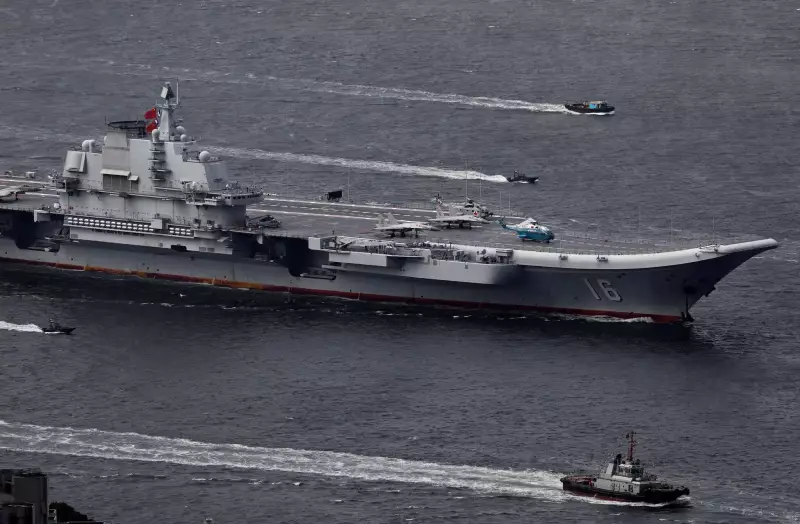
Japan and Australia have called for restraint after a significant escalation in the East China Sea, where Chinese military aircraft used their fire-control radar to lock onto Japanese fighter jets. The incident, which occurred on Saturday, has heightened regional tensions, coming just a month after Japanese Prime Minister Sanae Takaichi's comments on Taiwan strained relations with Beijing.
A Dangerous and Regrettable Act
Japanese Defense Minister Shinjiro Koizumi stated that Tokyo has formally protested what he termed an "extremely regrettable" and "dangerous" act. He emphasized that the Chinese actions "exceeded the scope necessary for safe aircraft operations." Koizumi confirmed that Japan has lodged a strong protest with China and demanded strict preventive measures to avoid a repeat.
According to Japan's Defense Ministry, the confrontation involved a Chinese J-15 fighter jet that took off from the aircraft carrier Liaoning near Okinawa. The J-15 intermittently locked its radar onto Japanese F-15 fighter jets on two separate occasions on Saturday. The first lock lasted for approximately three minutes in the late afternoon, followed by a second, longer incident of about 30 minutes in the evening.

Incident Details and Conflicting Narratives
The Japanese fighter jets had been scrambled to monitor Chinese aircraft conducting takeoff and landing exercises in the Pacific Ocean. Kyodo News agency, quoting defense officials, reported that the Japanese planes were maintaining a safe distance and were not engaged in any provocative maneuvers when the radar lock occurred. Japanese airspace was not breached, and no injuries or damage were reported.
In response, Senior Colonel Wang Xuemeng, a spokesperson for the Chinese navy, defended the flight training near Miyako Island. He stated that Beijing had announced the exercises in advance and accused Japanese aircraft of "harassment." In a statement posted on the Chinese Ministry of Defense website on Sunday, Wang demanded Japan "immediately stop slandering and smearing" and restrain its frontline forces, warning that the Chinese Navy would take necessary measures to safeguard its security.
Regional Repercussions and Diplomatic Fallout
The radar lock incident is believed to be the first of its kind involving Japanese and Chinese military aircraft, though a similar event occurred in 2013 when a Chinese warship targeted a radar on a Japanese destroyer. The latest event has further soured Japan-China relations, which deteriorated after Prime Minister Sanae Takaichi said in early November that Japan's military could get involved if China took action against Taiwan.
On Sunday, Takaichi called the radar lock-in "extremely disappointing" and vowed that Japan would "act calmly and resolutely," pledging to enhance surveillance around its waters and airspace. The development also drew concern from Australia, whose Defense Minister Richard Marles was in Tokyo for scheduled talks with Koizumi.
"We are deeply concerned by the actions of China in the last 24 hours," Marles said at a joint news conference. He stressed the expectation for all interactions to be "safe and professional" and reiterated that Australia does "not want to see any change to the status quo across the Taiwan Straits." Notably, Marles acknowledged China as Australia's largest trade partner and expressed a desire for productive relations, advocating for calm and sensible dialogue on these issues.
During their meeting, the Japanese and Australian defense ministers agreed to bolster military ties and lead multilateral defense cooperation in the region. They decided to form a comprehensive "framework for strategic defense coordination." This aligns with Japan's strategy of expanding its defense partnerships beyond its sole treaty ally, the United States, with Australia now considered a semi-ally. Marles also visited a Mitsubishi Heavy Industries shipyard in Nagasaki to observe the production of frigates Australia plans to acquire.

In a related development in the South China Sea, the Philippine coast guard reported that Chinese forces fired three flares toward a Philippine fisheries bureau plane on patrol on Saturday, highlighting the broader pattern of heightened military activity and tensions in the Indo-Pacific region.