

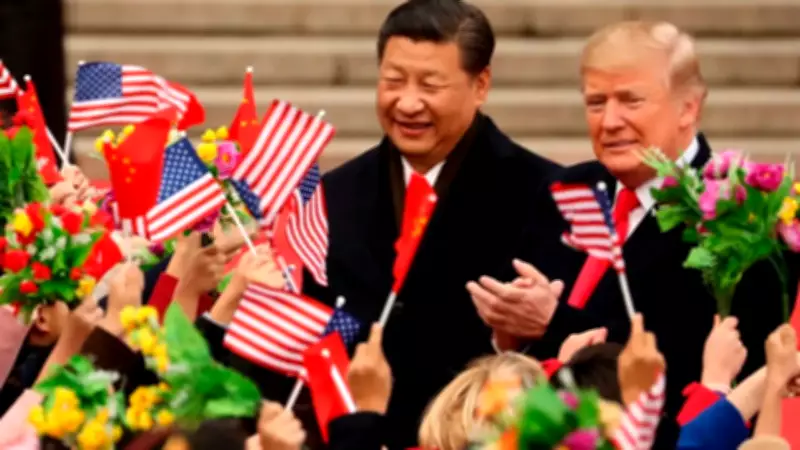
As Presidents Xi Jinping and Donald Trump gear up for a highly anticipated summit, both China and the United States affirm that their bilateral relations have remained broadly stable in recent months, with plans to maintain that trajectory. However, a multitude of contentious issues loom over one of the world's most consequential relationships, with no easy resolutions in sight.
Limited Breakthroughs Expected
Few analysts anticipate major breakthroughs in the long-standing frictions between the two nations, which span from technological competition to the delicate issue of Taiwan, whose primary ally is the United States. The agenda may also include ending the war with Iran, given Beijing's role as an unofficial mediator in the conflict.
"On both sides, there is a consensus that US-China stability is important," said Henrietta Levin, senior fellow for the Freeman Chair in China Studies at the Centre for Strategic and International Studies in Washington. "Once you get past the question of stability, the 'what's next' in the relationship gets a little more complicated, and so for that reason, the most likely thing to come out of the meeting is very little."

Trade Deal Possible, but Not a Resolution
The China-US trade war originated during Trump's first term and escalated in April last year on what Trump called "Liberation Day," when he announced 34% tariffs on all Chinese goods. China retaliated with counter-tariffs and other measures, such as restrictions on rare earth exports. Tariffs peaked at 145% amid the back-and-forth.
Recognizing the unsustainability of sky-high tariffs, both sides called for a trade truce, halting many punitive economic measures. The two leaders met in South Korea in October and extended the truce for another year. China pledged to purchase soybeans from American farmers, while the US reduced tariffs by more than half.
"China's strategy was to promote stability by fighting back," said Fudan University professor Zhao Minghao, an expert in international relations. "Both sides could very well issue a comprehensive trade agreement this time. But this doesn't mean the war is over, and the agreement will have conditions."
Last year's trade truce did not resolve broader issues, nor did it signify a return to previous norms. China now requires export permits for rare earth exports, which it can tighten at any time. Furthermore, "there's been a lack of the intensive type of engagement that has characterised past summits," said Wendy Cutler, vice president of the Asia Society and a former US trade negotiator.
In April, China issued new regulations to identify and counter foreign measures targeting Chinese companies. For example, China's Ministry of Commerce told impacted firms, such as a petroleum refinery buying Iranian crude oil, to ignore US sanctions. Although some predict a continuation of the trade truce, others note ongoing targeted actions. "It's a fragile truce," Cutler said. The White House announced plans to discuss creating a new "Board of Trade" to maintain economic dialogue.
High-Tech Chip Exports Remain Thorny
The US imposed restrictions on exports of advanced computer chips and related technology to China as early as Trump's first term. NVIDIA, a leading chip designer based in California, has urged Trump to allow exports to China. NVIDIA founder Jensen Huang argues that selling chips would build reliance on American tech for Chinese AI firms. However, increasing restrictions may push China toward self-reliance. "China's attitude has changed subtly; it seems more focused on advancing its domestic chip industry rather than continuing to rely on advanced chips from the United States," Zhao said.
Taiwan: The 'Biggest Risk' in Ties
Two weeks before the meeting, Chinese Foreign Minister Wang Yi told US Secretary of State Marco Rubio that bilateral relations have remained generally stable, but Taiwan is the "biggest risk" to ties. China signaled again that Taiwan would be a top priority for discussion. Few expect a resolution to the Taiwan issue, which has lingered since the 1949 civil war split. While Beijing claims Taiwan, the island is a self-ruled democracy.

Tensions have risen since Taiwan elected Tsai Ing-wen as president in 2016. Her Democratic Progressive Party (DPP) considers Taiwan functionally independent. Beijing has broken off communication with Taiwan's government and increased military drills near the island. Current President Lai Ching-te, also from the DPP, has been criticized by Beijing, even depicted as a "parasite" in propaganda imagery.
The US is legally required to help Taiwan defend itself but maintains "strategic ambiguity," leaving unclear whether it would intervene militarily if China attempted to reclaim Taiwan by force. Trump recently discussed arms sales to Taiwan with Xi, raising further questions. "One possibility is that China and the US can adopt a strategy of 'reciprocal restraint,' such as reducing US arms sales to Taiwan in exchange for fewer mainland military exercises aimed at Taiwan," Zhao said.
US Wants China to Pressure Iran
As the world awaits an end to the war with Iran, which has shaken the global economy, the conflict is likely to surface in talks. China has openly criticized the US and Israel over the war. Given its close ties with Iran, Beijing is seen as an unofficial mediator. However, China has remained cautious. "I don't think China has any interest in solving the problems the US has created for itself in the Middle East," Levin said.
Days before the trip, US Treasury Secretary Scott Bessent called on China to pressure Iran to open the Strait of Hormuz, accusing Beijing of funding terrorism by buying Iranian oil. "Let's see them step up with some diplomacy and get the Iranians to open the strait," Bessent said on Fox News. "Iran is the largest state sponsor of terrorism, and China has been buying 90% of their energy, so they are funding the largest state sponsor of terrorism."





