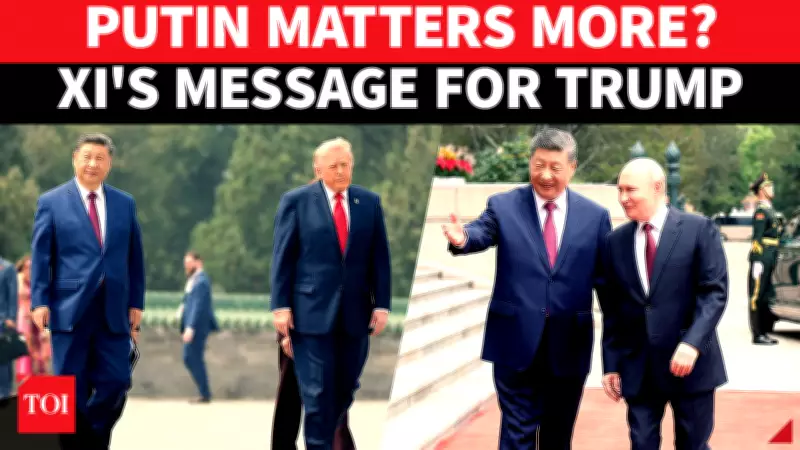
In the intricate world of Chinese diplomacy, who greets a visiting leader on the tarmac can be as telling as any closed-door meeting. Beijing recently sent a clear, albeit subtle, signal to Donald Trump by according a higher-level reception to Vladimir Putin.
Contrasting Welcomes
Both leaders received grand red carpet ceremonies, but the officials dispatched to meet them revealed a stark difference in status. Putin was welcomed by Foreign Minister Wang Yi, a senior member of Xi Jinping's Politburo. In contrast, Trump was greeted by Vice President Han Zheng, a figure with a largely ceremonial role and no real power within the Communist Party.
Symbolism of the Tarmac
This choice of greeters underscores China's internal hierarchy and its preference for Putin over Trump. Wang Yi's presence signals a high level of respect and political alignment, while Han Zheng's assignment suggests a more formal, less substantive relationship.

The diplomatic snub did not go unnoticed. Analysts interpreted it as a deliberate message from Beijing, reinforcing its strategic partnership with Russia while maintaining a more distant stance toward the United States under Trump.
This incident highlights how China uses ceremonial protocols to communicate political nuances, often more potent than words. As global power dynamics shift, such gestures become increasingly significant in shaping international relations.