

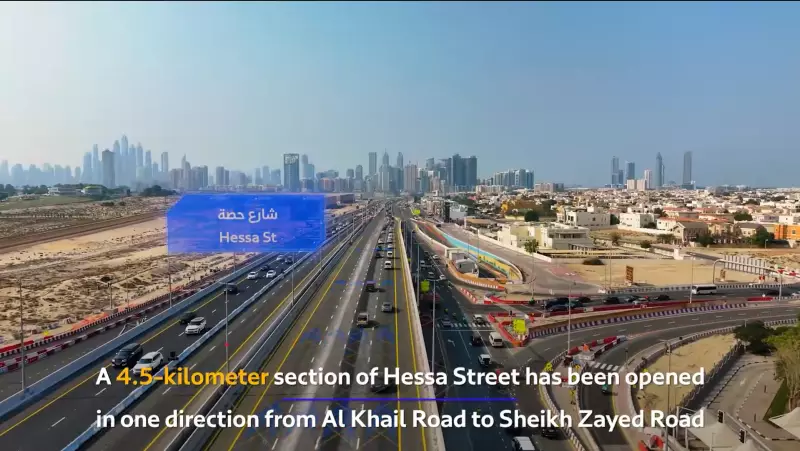
In a significant move to tackle chronic traffic congestion, Dubai's Roads and Transport Authority (RTA) has officially inaugurated the first phase of the ambitious Hessa Street Development Project. This marks a crucial step in the emirate's strategy to future-proof its transport network amidst rapid urban growth.
Major Road Widening and Bridge Upgrades
The newly opened Phase I spans 4.5 kilometres between the critical corridors of Al Khail Road and Sheikh Zayed Road. This phase represents nearly 90% of the entire project, with full completion targeted for later in 2026. The core of this phase involves the widening of Hessa Street from two lanes to four lanes in each direction, a change set to dramatically improve traffic flow to and from key arterial roads.
Substantial work has also been completed on major bridges and intersections. Key improvements include upgrades at Al Asayel Street, First Al Khail Street, and Sheikh Zayed Road. A notable addition is a two-lane directional ramp bridge over the Dubai Metro's Red Line at Sheikh Zayed Road, designed to facilitate smoother eastbound access during peak hours. The First Al Khail Street bridge has been widened from three to four lanes each way.

A Boost for Sustainable Mobility with Cycling Track
The project is not solely focused on cars. A standout feature is the construction of a 13.5-kilometre dedicated track for cyclists and e-scooters, running parallel to the road. This 4.5-metre-wide path aims to provide safe first- and last-mile connectivity between communities like Dubai Hills and Al Sufouh.
Enhancing this green commute option is a striking 5-metre-wide dedicated bridge for cyclists, e-scooter users, and pedestrians, allowing them to safely cross over both Sheikh Zayed Road and Al Khail Road. This infrastructure underscores Dubai's growing commitment to multi-modal and sustainable transport solutions.
Massive Impact on Capacity and Community Life
Mattar Al Tayer, Director General and Chairman of the RTA Board, stated that the AED 690 million (approx. $188 million) project aligns with the vision to advance road networks in sync with population growth. The benefits are expected to be far-reaching.
Once fully finished, the Hessa Street Development Project is projected to double the current traffic capacity from 8,000 to 16,000 vehicles per hour in both directions. This is expected to substantially reduce travel times and ease peak-hour congestion in one of the city's busiest corridors.
More than 640,000 residents in areas such as Al Sufouh 2, Al Barsha, and Jumeirah Village Circle are anticipated to benefit from these improvements by 2030. The redesign promises more predictable journeys through improved intersections and signalling, alongside enhanced safety for all road users, including drivers and non-motorised commuters.
This project is a key part of the RTA's larger plan to expand and upgrade Dubai's overall transport network, supporting the city's ambitious growth targets for 2030 and beyond.






