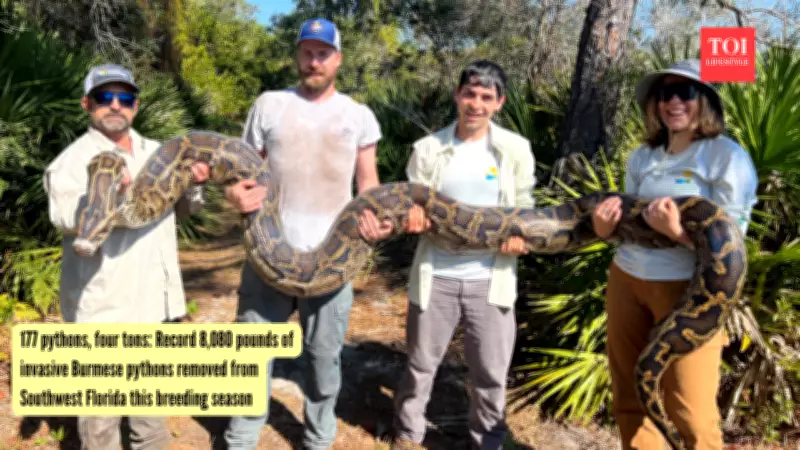
The Florida Everglades, one of the most extraordinary ecosystems on the planet, has been battling a slithering invasion for decades. Burmese pythons, native to Southeast Asia, have spread through South Florida's wetlands, swallowing native birds, mammals, and even deer, leaving stretches of the wild empty. These snakes breed quickly, hide brilliantly, and have no natural predators, making them one of the hardest invasive species to control.
Record-Breaking Python Season
For more than a decade, a small team of biologists in Southwest Florida has been searching the swamp to combat this invasion. This year, the Conservancy of Southwest Florida reported its most successful Burmese python season on record. From November 2025 to April 2026, biologists and volunteers captured 177 invasive snakes from a 200-square-mile stretch of Collier County, with a total weight of 8,080 pounds. According to their official website, this is the "greatest biomass of invasive Burmese pythons removed in a single season by the Conservancy’s python tracking team and volunteers since the program began in 2013."
Incredible Size of the Snakes
The average female removed this season weighed 95 pounds, while the largest stretched 17 feet and weighed 153 pounds. On average, each female carried around 70 eggs, and a quarter of them had remains of white-tailed deer inside. The sheer size of these snakes is hard to imagine.

Smart Tracking Techniques
The team used radio telemetry and 40 tagged male "scout snakes" to follow the males through mating season, tracking down large breeding females before they could lay eggs. "This was our first four-ton removal season. Our tagged scout snakes helped us locate large breeding snakes deep in the landscape before they had a chance to lay eggs," said Ian Bartoszek, the wildlife biologist and Conservancy science project manager who pioneered the program. This planning kept an additional 4,100 python eggs out of the ecosystem this season alone.
Long-Term Results
Since the program began in 2013, the Conservancy has removed 1,750 pythons weighing more than 53,000 pounds and contributed to 25 scientific publications on python biology and behavior, working with partners including the US Geological Survey and the University of Florida. Residents also play a role, as the Conservancy asks anyone who spots a python in Collier County to report it and stay nearby until a responder arrives.