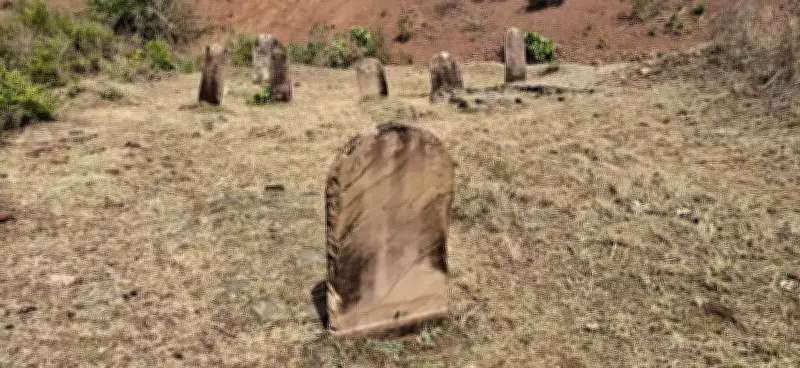
In Sironj, Vidisha district of Madhya Pradesh, about eight kilometers from the town on the road to Sarangpur village, a small marshy patch conceals seven weather-beaten stone markers. These graves, now over 160 years old, are silent witnesses to the prolonged unrest that followed the 1857 uprising. They have fallen into neglect and are all but forgotten, their inscriptions and stories at risk of being lost to time.
Locally Known as 'Gora Kabra'
Locally known as 'Gora Kabra' — the white people's graves — the site marks the final resting place of seven British soldiers and officers. According to historical accounts and local historians, these men fell in skirmishes with Indian freedom fighters between September and November 1859. Each marker carries inscriptions detailing the name, age, date of death, and military company of the deceased, though two stones record incomplete identities.
The markers commemorate men identified as Philip (aged 39), Colonel John Cunningham, Henry, Patrick, and Denimi, along with an unnamed sergeant and an unidentified colonel. All were reported to be between 25 and 39 years old at the time of death.

Neglect and Memories
Villagers say the graves were once encircled by a fired-brick boundary wall, but decades of neglect have reduced the enclosure to rubble. The immediate area, now a patch of barren farmland choked with seasonal vegetation, shows few visible signs of regular upkeep. Locals, however, recall occasional visitors who used to come many years ago to light candles at the stones, a small ritual that keeps the memory alive despite the site's dilapidated condition.
Historical Context
History records link the Sironj graves to the final chapters of the post-1857 resistance. After Rani Lakshmibai of Jhansi was martyred in 1858, prominent freedom fighter Tatya Tope moved through parts of central India — including Gwalior, Shivpuri, and Guna — and is said to have sheltered in the Sironj area for several days. Residents maintain that continued guerrilla activity in and around Sironj prompted British detachments to remain stationed locally well into 1859, and that clashes during this period produced the fatalities now commemorated at 'Gora Kabra'.
Archival scholarship supports the broader narrative that the conflict did not conclude neatly with the events of 1857. Instead, historians note, scattered pockets of resistance persisted across central India, where hit-and-run tactics and local uprisings prolonged violence and hampered British consolidation of control. The Sironj site offers a tangible reminder that the upheaval touched not only celebrated battlefields but also quieter rural locales.
Preservation Urged
Preservationists and local historians are urging documentation and conservation of Gora Kabra before weathering and neglect erase the inscriptions and weathered stones entirely. They argue that preserving the markers would enrich public understanding of the region's role in the protracted struggle for independence and serve as a local monument to the complex, often messy aftermath of the 1857 uprising.
Shoaib Ghazi, who has launched a social media campaign to draw attention to Sironj's historical legacy, warned that the town's vast heritage is being neglected. 'It is imperative to preserve this heritage before these historical artifacts vanish,' Ghazi said, urging authorities and residents to act quickly to save monuments and relics that he says are slipping into disrepair.
Sironj chief municipality officer Ramprakash Sahu said, 'The seven graves fall under the jurisdiction of the panchayat and only they can take the necessary steps to save them.' Panchayat officials, however, declined to comment.
For now, the seven stones stand as mute witnesses — weathered relics that mark a contested moment in history and a community's fragile effort to remember a turbulent past.