

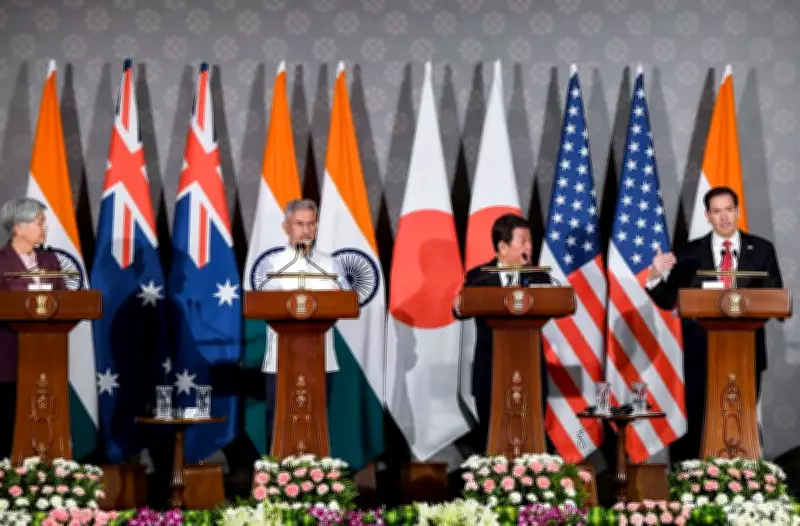
The geopolitical landscape of the Indo-Pacific is increasingly defined by the interplay of four major democracies: the United States, India, Japan, and Australia. Together, they form the Quadrilateral Security Dialogue, or Quad, a strategic forum aimed at ensuring a free and open Indo-Pacific. However, the growing assertiveness of China, often referred to as the 'dragon in the room,' presents a complex challenge that tests the cohesion and resolve of these nations.
Shared Interests and Divergent Priorities
While the Quad members share a common interest in upholding maritime rules and freedom of navigation, their individual priorities can diverge. For India, the primary concern is China's military buildup along the Line of Actual Control and its strategic partnerships with Pakistan. Japan focuses on the East China Sea and territorial disputes with China. Australia is increasingly wary of China's influence in the Pacific Islands, while the United States views China as a strategic competitor on a global scale.
Economic Interdependence vs. Security Concerns
One of the most significant challenges for the Quad is balancing economic interdependence with China against security concerns. China is a major trading partner for all four countries, making economic decoupling a painful prospect. This creates a delicate dance where each nation must weigh the benefits of trade against the need to counterbalance Beijing's assertive behavior.

The Quad has made progress in practical areas such as vaccine distribution, infrastructure development, and technology cooperation. However, critics argue that the forum lacks a unified military strategy and a clear mechanism for crisis management. The recent AUKUS pact between the US, UK, and Australia has also raised questions about the Quad's coherence, as it excluded India and Japan.
The Dragon's Response
China has responded to the Quad's initiatives with a mix of criticism and counter-proposals. Beijing labels the Quad as an 'exclusive club' aimed at containing its rise and promotes its own vision of regional order through the Belt and Road Initiative and the Regional Comprehensive Economic Partnership. The South China Sea remains a flashpoint, with China constructing artificial islands and militarizing outposts, challenging the norms of freedom of navigation.
Despite these tensions, there are areas where cooperation with China is essential, such as climate change, pandemic response, and nuclear non-proliferation. The Quad members must navigate these complexities carefully to avoid a full-blown confrontation while protecting their strategic interests.
Path Forward
The future of the Quad depends on its ability to evolve from a consultative forum to a more action-oriented mechanism. This includes deepening intelligence sharing, conducting joint military exercises, and coordinating responses to cyber threats. Additionally, the Quad should engage other like-minded partners in the region, such as South Korea, New Zealand, and ASEAN countries, to build a broader coalition for a free and open Indo-Pacific.
In conclusion, the four democracies face a common challenge in the form of China's rising power. Their ability to maintain unity, manage internal differences, and present a credible alternative to Beijing's vision will determine the stability and order of the Indo-Pacific region for decades to come.






