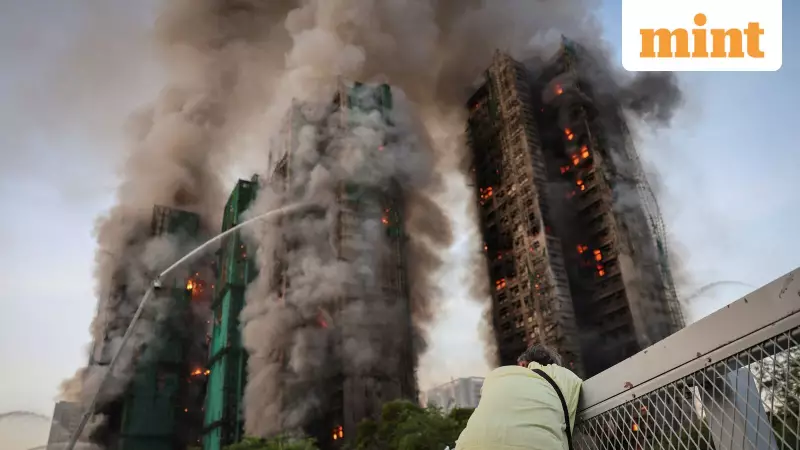
The devastating fire that tore through a public housing estate in Hong Kong's Tai Po district last week was a catastrophe of almost unimaginable scale. Yet, for one journalist on a work trip in the city, the tragedy was underscored by an unexpected modern phenomenon: a deluge of misplaced concern from friends overseas.
The Blaze That Gripped a City
The inferno, which began on Wednesday evening, 27 November, and raged until Friday, 29 November, engulfed as many as eight residential towers, each 30 storeys high. The fire spread with terrifying speed, fueled by highly flammable synthetic netting used to cover buildings under refurbishment. Despite a massive deployment of 2,000 firefighters, controlling the blaze was a prolonged battle. The human cost was staggering, with at least 151 lives lost, prompting the city to declare three days of mourning.
Rahul Jacob, a former Financial Times correspondent, was in Hong Kong during the disaster. However, he was located in the central financial district, roughly 30 kilometres away from the Tai Po public housing complex. His experience highlights a disconnect fostered by 24-hour news cycles and viral social media clips.

The Flood of Misplaced Anxiety
"I was unprepared for the flurry of texts I received from friends," Jacob notes, describing messages that ranged from commiseration to urgent safety checks. This reaction, though well-intentioned, revealed a common distortion. The relentless, graphic coverage of the disaster created a global sense of proximity to the event, blurring the vast geographical and socio-economic distances within Hong Kong itself.
While the fire raged, Jacob was attending a classical music concert in central Hong Kong. "My primary concern was that the lead violinist not break a string," he recalls, drawing a stark contrast between his reality and the dystopian scenes unfolding elsewhere in the city. He acknowledges the unsettling privilege of being a world away from a tragedy in the same urban space, a guest in a high-floor penthouse rather than a resident of the afflicted public housing.
A Spotlight on Neglect and Priorities
Beyond the immediate horror, the fire cast a harsh light on a long-standing issue in one of the world's wealthiest cities: the substandard quality of its public housing. Jacob points out that this critical context was largely missing from global coverage. Despite Hong Kong's immense wealth and a massive accumulated fiscal surplus of US $70 billion, its public housing has historically lagged behind standards in cities like Singapore and even London.
The tragedy echoes the 2017 Grenfell Tower fire in London, which also exposed fatal flaws in maintenance and safety. Jacob suggests the city-state's priorities have long resembled those of a plutocracy, citing the example of a wine duty cut in 2007 by a financial secretary known for his exquisite collection. The incident raises urgent questions about resource allocation and social responsibility.
Jacob connects the instant, often misguided, outreach he received to a broader culture of "hyper-anxiety" amplified by non-stop news, a point author Yann Martel made two decades ago during the US invasion of Iraq. This well-meaning but uninformed concern can become an additional burden for those actually dealing with a crisis, as Jacob later realized when he himself sent anxious texts to friends during floods in Sri Lanka.
The Hong Kong fire is a grim reminder. While our connected world allows for immediate expressions of empathy, true concern requires understanding context and channeling energy into constructive action—whether that's supporting disaster relief agencies or demanding better governance and housing standards for the most vulnerable.