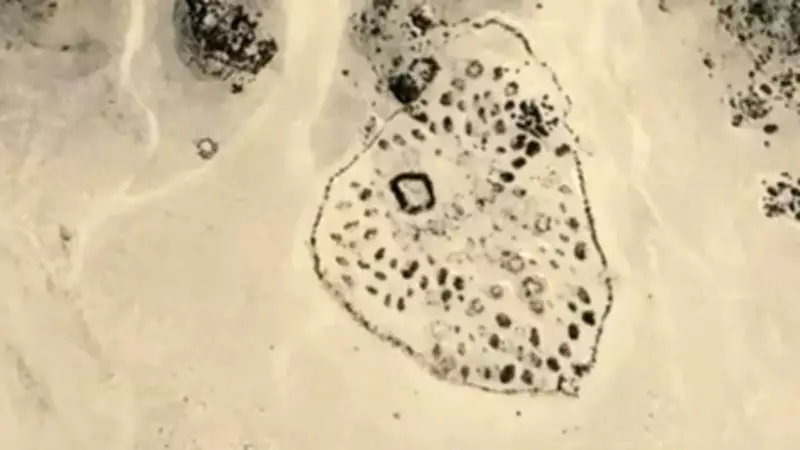
A team of archaeologists has uncovered 260 previously unknown circular mass graves in the Atbai Desert of eastern Sudan using satellite remote sensing. These structures, known as enclosure burials, date back to the fourth and third millennia BCE and contain the bones of humans and animals, often arranged around a central figure.
Discovery and Significance
The research, published in the African Archaeological Review, was conducted by an international team from Macquarie University, France's HiSoMA research unit, and the Polish Academy of Sciences. They systematically analyzed satellite imagery across nearly 1,000 kilometers of desert east of the Nile River. The enclosures feature large round walls up to 80 meters in diameter, with humans buried alongside cattle, sheep, and goats.
Who Built Them?
These monuments were created by Saharan desert nomads who lived between 4000 and 3000 BCE, predating Pharaonic Egypt. Unlike the agricultural Egyptians, these people were herders who roamed the arid landscape. The presence of secondary burials around a primary central burial suggests an emerging social hierarchy, possibly indicating the rise of an elite class. This marks an early stage of inequality, though not as pronounced as in later civilizations like Egypt.

Role of Cattle
Cattle held great importance for these nomads, as evidenced by their inclusion in burials and local rock art. Burying animals alongside humans may have been a status symbol, akin to owning a luxury item today. The practice reflects the value placed on livestock in a challenging environment.
Climate Context
The monuments are located near ancient watering spots, such as rocky pools and lakebeds, indicating that the Sahara was already drying during the African Humid Period. As the monsoon retreated, pastures shrank, forcing nomads to abandon cattle or migrate. The burials represent a response to climate change, showcasing adaptation strategies.
Enduring Legacy
Local nomads reused these enclosures for burials thousands of years later, demonstrating their lasting significance. However, many sites are now threatened by unregulated mining, which can destroy them in less than a week. The discovery reshapes understanding of Sahara prehistory, highlighting organized nomadic societies that preceded the monumental cultures of Egypt and Nubia.