

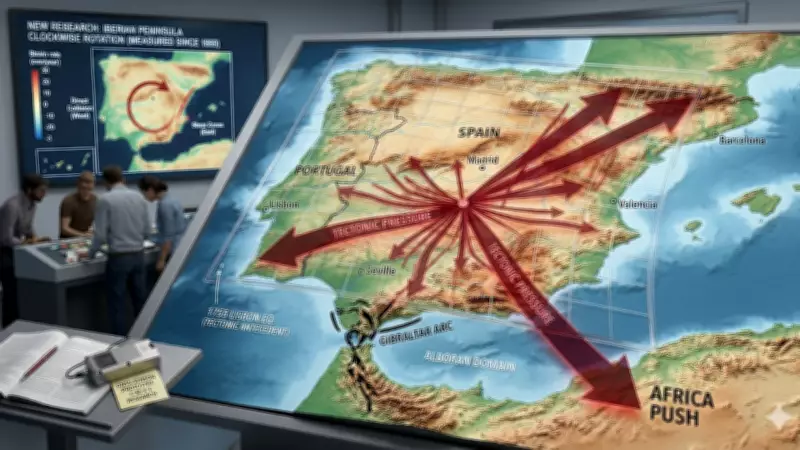
According to new research on the geodynamics of Earth’s crust, the Iberian Peninsula, which includes Spain and Portugal, is turning clockwise due to the pressure applied by the African and Eurasian plates. The study, based on earthquake data, crustal deformation analysis, and GNSS satellite observations, found that the peninsula is moving and rotating. Scientists from the University of the Basque Country attribute these changes to stress accumulation in the Strait of Gibraltar and the Alboran Sea. This discovery will help create a more accurate map of earthquake risks in southern Europe and North Africa.
Tectonic Movement Beneath Spain and Portugal Explained
While Spain and Portugal appear stable on maps, the landmass they occupy is gradually moving. A team from the Geology Department at Tanta University analyzed decades of seismic activity and precise GNSS data to determine crustal movements within the Iberian Peninsula. Their unexpected results showed a clockwise rotation as Africa approaches Eurasia. Study co-author Mohamed K. Salah stated, “The new data support the idea that the Iberian Peninsula is rotating clockwise.” The findings were published in Gondwana Research. The African and Eurasian tectonic plates converge at 4-6 mm per year—a small but significant rate that will reshape landscapes over millennia.
How Earthquakes and Satellite Data Revealed Iberia’s Rotation
The research combined seismic stress patterns from earthquakes with satellite observations detecting ground motion at millimeter-level precision. The most complex processes occur near the Strait of Gibraltar and the Alboran zone in southern Spain, where extreme stress arises from the Africa-Europe collision. Stress and deformation are not uniform; some areas concentrate stress while others transmit movement inland. The plate boundary is less defined than previously thought. GNSS satellites across Spain, Portugal, and Morocco enabled detection of minor crustal deformations invisible to humans. Notably, western Iberia rotates differently from its eastern counterpart. The study identified new active faults that could trigger future seismic events.

Why the Iberian Peninsula’s Movement Matters
Although the movement is imperceptible over human lifetimes, the findings have significant implications. Understanding how tectonic strain transfers across Iberia may help predict earthquakes in urban centers like Lisbon and Seville, as well as around the western Mediterranean basin. It also advances knowledge of continental drift. Scientists warn that continued convergence of Africa and Europe will eventually transform the Mediterranean region. Previous geological investigations, such as a 1969 paleomagnetic study published in Tectonophysics, had suggested Iberian rotation relative to Europe over geological time.
Scientists Say Iberia Is Constantly Changing
A key lesson is that even seemingly fixed landmasses are not static. The Earth’s crust is in perpetual motion, with minute annual changes eventually altering landscapes and fault lines. Scientists expect that additional measurements from oceanic stations around Iberia and North Africa will further reveal deformation and rotation. Current data already suggest that Spain and Portugal are slowly merging due to rotational movements of the Iberian landmass.






