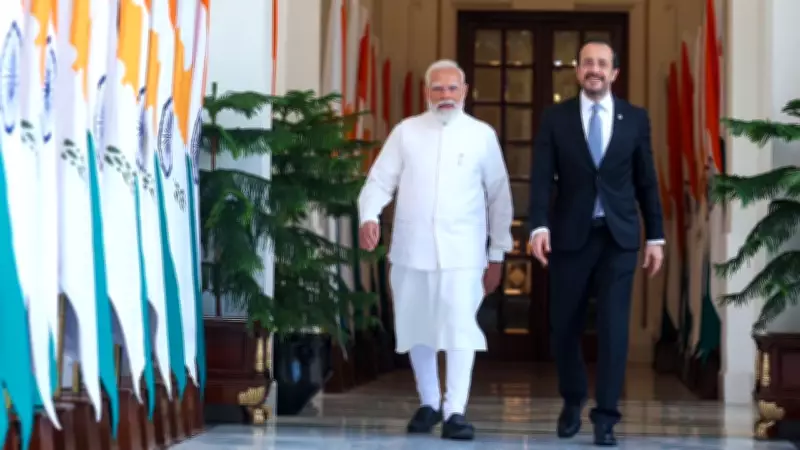
India and Cyprus have announced the elevation of their bilateral relationship to a strategic partnership, marking a new chapter in their ties. The announcement came after talks between Prime Minister Narendra Modi and visiting Cypriot President Nikos Christodoulides in New Delhi. According to senior Cypriot officials, both sides are looking to boost bilateral investments, including Indian investments in Cyprus in sectors ranging from defence to tourism.
Geostrategic Context and Defence Opportunities
Given Cyprus’s geostrategic position on the edge of West Asia and the Eastern Mediterranean, and against the backdrop of Russia’s war of aggression against Ukraine and the conflict in Iran, Nicosia is looking to shore up its own defence capabilities using financial support from the EU SAFE programme. Cyprus is entitled to 1.2 billion euros in loans under this head. Crucially, not being a NATO member, Cyprus enjoys greater flexibility in defence procurement as opposed to rigid NATO standards. This opens up opportunities for Indian defence manufacturers to supply equipment and expertise.
Turkey Factor
The elephant in the room is Turkey. India fully supports Cyprus’s sovereignty and territorial integrity, pushing back against the internationally unrecognised Turkish Republic of Northern Cyprus. Additionally, since India’s Operation Sindoor last year and Turkey’s overt and covert support to Pakistan, New Delhi-Ankara ties have turned cold. This is providing impetus to geostrategic projects such as the India-Middle East-Europe Economic Corridor (IMEC), which is opposed by Ankara.

IMEC and Economic Corridors
IMEC has received a further fillip in light of the Iran war, which has sparked the search for alternative trade routes and supply chains. Cyprus, as the entry point for Europe, is a key pillar of IMEC. Notably, Cypriot ports do not have Chinese stakes. Plus, Cyprus has worked to almost eliminate Russian stakeholding in the Cypriot banking system – Russian deposits are down from 87% to around 1% – with Nicosia extending strong, principled support to Ukraine in the face of Russia’s aggression. Nicosia is now looking to start building the foundational blocks of IMEC, particularly through enticing private investments. True, the Iran war and current complications between Saudi Arabia and the UAE act as impediments. That is why Cyprus is ready to begin work in the European part of the corridor first.
India’s Opportunity and Challenges
For India, IMEC presents a huge opportunity, particularly in light of the recent India-EU Free Trade Agreement. But competing trade corridors such as China’s Belt and Road could undermine IMEC’s takeoff. A China-Pakistan-Russia-Turkey corridor directly challenges the India-Middle East-Cyprus-Europe one backed by the US. Against this backdrop, India and Cyprus coming together to secure supply chains, diversify trade routes, and boost regional security acts as a countervailing force against China’s weaponisation of economic interdependencies, Turkey’s manoeuvres in West Asia, and Pakistan’s machinations.