

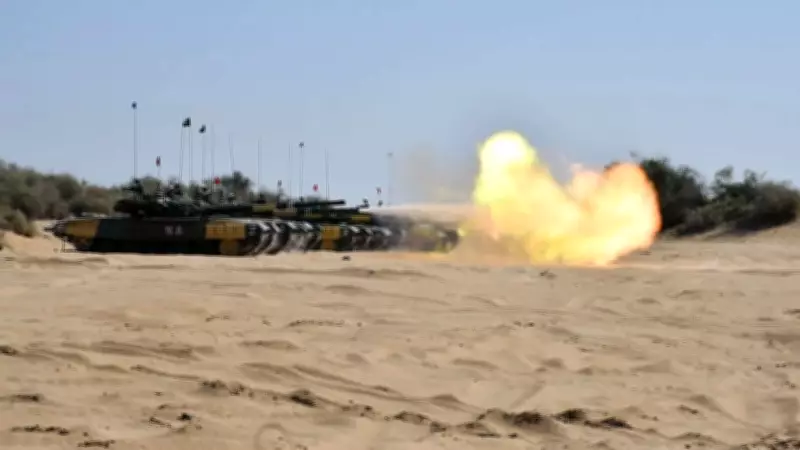
The Indian Army is planning a major battlefield upgrade for its ageing fleet of T-72 tanks, with an eye on China and Pakistan. The T-72 tank was first inducted in 1978, and at that time, it was considered one of the most advanced armoured fighting vehicles globally. It featured a powerful 125 mm gun, sophisticated fire-control systems, a low silhouette that made targeting difficult, and a favourable power-to-weight ratio. The tank gave the Indian Army a significant edge over its adversaries upon induction.
In the West, Pakistan was phasing out its Patton tanks and inducting derivatives of the Chinese Type-59, followed later by the Type-69 and Type-85 tanks, as well as around 300 T-80 tanks acquired from Ukraine. However, modern Western tanks inducted in the 1980s proved to be more than a match for the T-72 during the first Gulf War in 1991. Western tanks, equipped with superior sighting systems—particularly thermal imagers and night-vision devices, along with advanced fire-control systems—shifted the balance decisively in favour of the Western coalition.
Move to T-90 Tanks
The Indian Army, meanwhile, moved on to acquire the more modern T-90 tanks, which are based on the T-72 platform. The Army first inducted these tanks in 2001, with the initial batch of 124 tanks manufactured in Russia. Just last week, Armoured Vehicles Nigam Limited (AVNL), located in Avadi, Tamil Nadu, delivered the 1,000th T-90 tank to the Indian Army.

Project Rhino: Modernising the T-72
The Indian Army’s first major attempt at modernising the T-72 was called Project Rhino, aimed at upgrading the tank to modern battlefield standards. Under the programme, the tanks are to receive new engines, advanced fire-control systems, improved protection systems, and could even be converted into unmanned combat platforms under the Aditi 4.0 challenge initiative. These measures are intended to extend the service life of the T-72 well beyond 2030 while preparing the ground for the eventual induction of the Future Ready Combat Vehicle.
This upgrade is seen as crucial for maintaining a credible armoured force in the face of evolving threats from China and Pakistan, ensuring that India's tank fleet remains competitive on the modern battlefield.






