Nine years after Prime Minister Narendra Modi and former Japanese Prime Minister Shinzo Abe flagged off India's first bullet train project between Mumbai and Ahmedabad in 2017, the ambitious rail infrastructure plan is still racing through construction stages. With the high-speed rail corridor achieving several key milestones, many are now eagerly waiting for the launch of India's first bullet train ride.
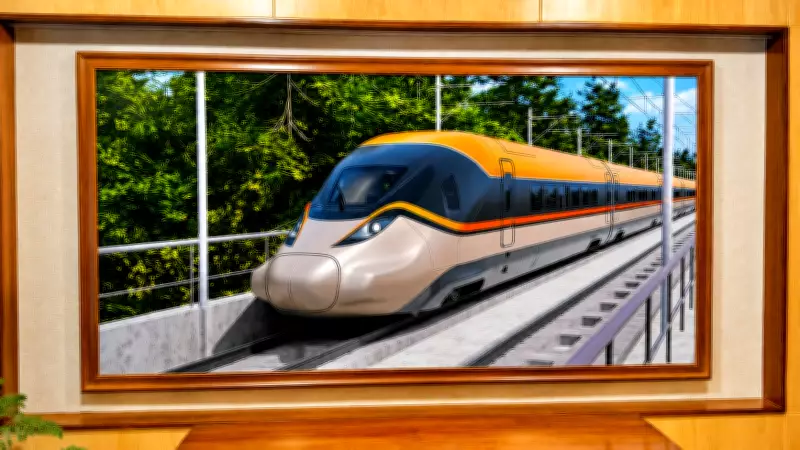
Earlier, Union railway minister Ashwini Vaishnaw shared the latest progress update on the Mumbai-Ahmedabad bullet train corridor. According to the minister, 349 km of viaduct work has already been completed on the 508-km route. However, the recently shared image is not how the train will finally look; it is only for representation.
The 508-km Mumbai-Ahmedabad High Speed Rail (MAHSR) corridor, being built with Japanese technical and financial support, had faced major delays earlier, especially in Maharashtra due to land acquisition issues. The bullet train network also includes India's first undersea rail tunnel beneath Thane Creek, stretching around 7 km. Officials now say work has picked up across several sections of the route.

Key Milestones Achieved
Here is what has been accomplished so far:
- Entire land required for the project, 1,389.5 hectares, has been acquired.
- All statutory clearances have been received and all 1,651 utilities shifted.
- Around 349 km of viaduct structure has been completed on the corridor. Nearly 90 per cent of the bullet train route will run on elevated tracks.
- A total of 443 km of piers, or concrete support pillars, has been constructed.
- More than 7,700 overhead equipment masts have been installed across 179 km.
- Track bed construction has progressed over 374 track-km.
Progress in Gujarat
In Gujarat, foundation and pier work has reached 352 km each. Girder casting has reached 342 km, while girder launching has crossed 331 km. Track bed construction has reached 152 km, and overhead mast erection has touched 121 km.
Progress in Maharashtra
In Maharashtra, foundation work has reached 74 km and pier construction 65 km. Girder casting has reached 9 km and girder launching 3 km.
Station and Bridge Work
Out of 12 planned stations, foundation work has been completed at eight stations: Vapi, Bilimora, Surat, Bharuch, Anand, Vadodara, Ahmedabad and Sabarmati. Seventeen river bridges have already been completed.
Current Status
In Maharashtra, work is underway at Thane, Virar and Boisar stations. Excavation work at the underground Bandra-Kurla Complex (BKC) station in Mumbai is close to completion. The National High Speed Rail Corporation Limited (NHSRCL) recently lowered the cutter head of India's largest tunnel boring machine into a launch shaft at Vikhroli in Mumbai. The machine weighs around 350 tonnes and has a diameter of 13.6 metres.
Work is at an advanced stage on four major bridges across the Narmada, Mahi, Tapti and Sabarmati rivers in Gujarat. Construction is also underway on four river bridges in Maharashtra. Work on depots at Thane, Surat and Sabarmati is progressing.
Indigenous Manufacturing
The project is also moving towards indigenous manufacturing. In late 2024, the Integral Coach Factory awarded an Rs 867-crore contract to Bengaluru-based BEML to design and manufacture India's first domestically built high-speed trains for the corridor. The trains are expected to operate at around 250 kmph, with a design speed of 280 kmph. However, the corridor infrastructure is being built for speeds up to 320 kmph.
Services and Travel Time
Two types of services are planned on the route. The faster service, stopping only at Surat and Vadodara, is expected to cut travel time between Mumbai and Ahmedabad to a little over two hours. At the same time, the all-stop service is expected to complete the journey in under three hours. Currently, regular trains between Mumbai and Ahmedabad take nearly seven hours to complete the journey, while the Vande Bharat Express covers the route in around five-and-a-half hours.

Fares and Feasibility
Ticket fares for the bullet train are proposed to remain competitive compared to existing rail and air travel options on the route. The project's feasibility has been evaluated over the long term, factoring in expected passenger demand, economic gains, travel time reduction and regional development.
Described as a highly complex and technology-driven project, the bullet train initiative has been developed with support from Japanese railway systems, with a focus on maintaining the highest safety standards and maintenance protocols. The system has also been adapted to suit Indian requirements and weather conditions.
According to the government, a clear timeline for completion can only be determined after work related to civil structures, tracks, electrical systems, signalling, telecommunications and trainset supply is completed.