

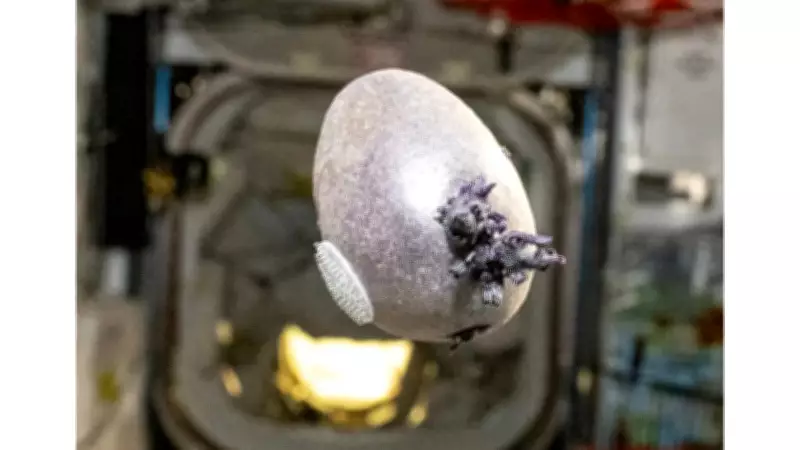
ISS 'Alien Egg' Mystery Solved: It's Just a Space-Grown Purple Potato
A bizarre, tentacled object spotted floating aboard the International Space Station recently ignited a firestorm of speculation across the internet, with many viewers convinced it was a creature straight out of a science fiction horror film. The eerie, deep purple, egg-shaped form with sprawling tendrils quickly went viral, triggering reactions that ranged from intense curiosity to genuine alarm. However, the reality behind this unsettling image is far more mundane and scientifically fascinating. The object is, in fact, a simple purple potato that was cultivated in microgravity by veteran NASA astronaut Don Pettit as part of a small-scale gardening experiment. This incident offers a compelling glimpse into the challenges and oddities of growing food beyond Earth's atmosphere.
The Viral 'Alien Egg' That Unsettled the Internet
The image did not merely circulate online; it profoundly disturbed many who encountered it. At first glance, the object bore an uncanny resemblance to a living organism, an organic form suspended in the void of space with tendrils stretching outward as if blindly seeking direction. Its unnaturally smooth, almost synthetic-looking surface, combined with its intense purple coloration, made it appear less like a vegetable and more like a sinister prop from a cinematic alien invasion story. In the weightless environment of the ISS, where all familiar earthly reference points vanish, even the most ordinary objects can undergo a startling visual transformation.
As the photograph spread virally across social media platforms, wild speculation followed. Some users nervously joked about the discovery of extraterrestrial life, while others expressed sincere unease, utterly unable to reconcile the image with anything recognizable from their daily lives. The complete absence of any immediate context only served to intensify the public's reaction. Detached from a straightforward explanation, the mysterious object became a blank canvas for human imagination, a cosmic riddle shaped more by collective fear and wonder than by factual reality. A routine biological process—a potato beginning to sprout—was rendered eerie and alien simply because it was occurring in an utterly unfamiliar, zero-gravity setting. It was not the object itself that had changed, but the extraordinary conditions surrounding it and the human perspective through which it was viewed.

The Simple Truth: A Potato Sprouting in Zero Gravity
Behind the viral mystery lies a remarkably straightforward scientific explanation. The object is an early-stage purple potato that has naturally begun to germinate and sprout. The strange, hair-like tendrils are merely its natural roots and shoots emerging as part of its standard life cycle. On Earth, these growths would typically be guided in specific directions by the unyielding pull of gravity and the physical constraints of surrounding soil. In the microgravity environment of space, that fundamental organizing force disappears entirely.
Without gravity to provide orientation, the potato's sprouts extend outward chaotically in multiple, seemingly random directions, creating a form that appears disorganized and deeply unfamiliar to earthbound observers. This profound lack of directional growth is the primary factor giving the space potato its bizarre, otherworldly appearance. What would normally remain hidden and unseen beneath the soil on Earth becomes fully visible, suspended and exposed in the open cabin air, transforming a common agricultural process into something visually arresting and strangely beautiful.
How Astronaut Don Pettit Cultivated a Potato on the ISS
Growing any form of plant life aboard the International Space Station demands significant adaptation and ingenuity. In an environment where every object floats freely and gravity provides no guidance, even the most basic agricultural processes must be completely reimagined and redesigned. Astronaut Don Pettit tackled this unique challenge with a practical, improvised setup, utilizing only the limited resources readily available on the orbiting laboratory.

A controlled, artificial light source effectively replaced sunlight, supplying the essential energy required for the potato to initiate photosynthesis and begin sprouting. The immediate environment around the tuber was loosely contained to help maintain stability, while a small patch of reliable hook-and-loop Velcro ensured the potato remained securely anchored to a surface, preventing it from harmlessly drifting through the station's modules. In this novel system, moisture and light intensity became the primary environmental cues guiding the vegetable's development.
Without soil to physically constrain it and without gravity to directionally direct it, the potato responded in unexpected ways. Its overall growth was noticeably slower, far less structured, and more exploratory in nature. Although this particular experiment was modest in its scope, it successfully demonstrated a critical principle: that biological life can adapt and persist even under conditions radically different from those on its home planet.
The Man Behind the Experiment: Astronaut-Scientist Don Pettit
Don Pettit is a highly experienced NASA astronaut and scientist renowned for his hands-on, curiosity-driven approach to experimentation in space. He has built a distinguished reputation for meticulously observing how everyday physical and biological processes behave when completely removed from Earth's familiar constraints, from studying fluid dynamics to cultivating simple plants.
The now-famous potato experiment was not a formal part of any predefined NASA mission objective. Instead, it emerged directly from Pettit's own persistent personal curiosity about living biological systems in microgravity. Beneath that surface-level curiosity, however, lies a deeply practical and pressing concern for the future of human space exploration. As global space agencies actively prepare for much longer-duration missions to the Moon and eventually to Mars, the ability for crews to reliably grow their own fresh food becomes not just advantageous, but absolutely essential for mission sustainability and crew health. Pettit's informal, observational work, therefore, makes a valuable contribution to this broader, crucial body of knowledge.
Why a Purple Potato? The Science of Its Vivid Color
The potato's striking deep purple color originates from naturally occurring antioxidant pigments called anthocyanins, which are also abundantly found in foods like blueberries, blackberries, and red cabbage. These potent compounds are solely responsible for the tuber's vivid, almost neon hue and are widely studied for their associated health and antioxidant properties.
Importantly, the potato's unusual purple coloration is not a bizarre result of its exposure to space conditions, but rather a characteristic of its specific, earth-bred variety, which was genetically selected to naturally produce high concentrations of anthocyanin pigments. All potatoes belong to the same botanical species, Solanum tuberosum, yet different cultivated varieties express wildly different visual and nutritional characteristics depending on their unique genetic makeup.
Selecting a purple variety for such microgravity experiments offers a clear practical and visual advantage. Its intense, uniform color makes subtle physiological changes and growth patterns significantly easier for researchers to observe and document accurately in an environment where conventional growth cues and markers are entirely absent.
Why It Appeared So Smooth and Unnaturally Alien
The potato's peculiarly smooth surface texture significantly contributed to the overall alien illusion. As a young, freshly sprouted specimen, its skin was naturally very thin and smooth. In the pristine, soil-free environment of the space station, it remained impeccably clean, free from the usual scuffs, dirt marks, and irregular textures typically seen on Earth-grown potatoes harvested from the ground. Furthermore, without gravity exerting constant pressure from a single direction, its overall shape remained more symmetrical and uniform, lending it an almost artificially manufactured appearance.
The specialized lighting conditions aboard the ISS further amplified this uncanny visual effect. Under the controlled, intense glow of the station's grow lights, the potato's purple anthocyanin pigments appeared even more vibrant and saturated, dramatically enhancing the pervasive sense that this was an object utterly unfamiliar and not of this world.
The Critical Importance for Future Space Exploration
What initially appeared as a mere viral internet curiosity is, in reality, intimately connected to one of the most significant challenges facing future human spaceflight. Ambitious future crewed missions to establish bases on the Moon and to eventually colonize Mars will require astronauts to sustainably support themselves over extended periods without the possibility of constant, rapid resupply from Earth. Consequently, growing nutritious food efficiently in space has transitioned from an abstract scientific concept to an absolute operational necessity.
Potatoes are widely considered a strong leading candidate for such extraterrestrial agricultural efforts due to their excellent nutritional density, high caloric yield, and relatively efficient use of water and space. Small-scale, pioneering experiments like Don Pettit's, even when conducted informally, contribute vital data points to the growing international body of knowledge regarding how various food crops behave and can be managed in microgravity and partial-gravity environments, informing the design of future sustainable life-support and bio-regenerative systems.
When the Mundane Becomes Extraordinary
The global reaction to the so-called "alien egg" aboard the ISS ultimately reveals far more about the quirks of human perception and context than about the object itself. Completely removed from its familiar earthly context—a dark, damp soil bed—a common, humble potato was psychologically transformed into something unsettling, mysterious, and seemingly otherworldly.
In the final analysis, the viral image is not an unsolved cosmic mystery but rather a poignant reflection of how effortlessly the utterly familiar can be visually and psychologically transformed when placed in an alien setting. In space, where the fundamental rules of everyday terrestrial life no longer apply, even the simplest, most natural act—a potato beginning its life cycle—can appear to be something entirely unknown and wondrous.
And yet, at its very core, it remains precisely what it has always been: a small, hopeful attempt to nurture and grow life, far from its planetary home.





