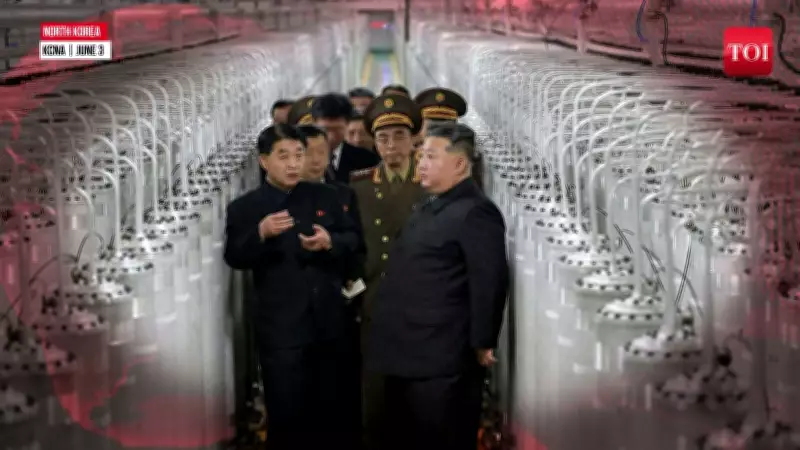
North Korea has unveiled a new nuclear bomb fuel facility and announced plans to expand its nuclear forces at an exponential rate, directly defying former US President Donald Trump. State media released images showing what appears to be a sophisticated uranium-enrichment complex packed with centrifuges capable of producing weapons-grade material.
Kim Jong Un's Announcement
Kim Jong Un claimed that North Korea's nuclear material production capacity has more than doubled in five years. This revelation comes amid ongoing tensions with the United States and South Korea, as Pyongyang continues to advance its nuclear program despite international sanctions and diplomatic efforts.
Global Implications
The unveiling of the facility marks a significant escalation in North Korea's nuclear ambitions. Experts warn that the expansion could lead to a new arms race in the region, prompting responses from neighboring countries and the international community. The International Atomic Energy Agency (IAEA) has expressed concern over the lack of transparency and the potential for further proliferation.

This development is seen as a direct challenge to US foreign policy, particularly in the Asia-Pacific region. South Korea has condemned the move, calling for stronger sanctions and a unified international response. The United States has yet to issue an official statement, but analysts anticipate a firm reaction from Washington.
Technical Details
The newly revealed facility is believed to be a centrifuge plant for uranium enrichment, a critical step in producing nuclear weapons. Images released by state media show rows of advanced centrifuges, indicating a level of sophistication that surpasses previous estimates. This facility is part of a broader push by North Korea to modernize and expand its nuclear arsenal.
Historical Context
North Korea has conducted six nuclear tests since 2006 and has been developing intercontinental ballistic missiles capable of reaching the US mainland. The latest announcement suggests that Pyongyang is accelerating its efforts to achieve a credible nuclear deterrent, despite economic hardships and international isolation.
The international community, including the United Nations, has imposed multiple rounds of sanctions aimed at curbing North Korea's nuclear activities. However, these measures have had limited success, as Pyongyang continues to find ways to advance its program. The IAEA has been unable to inspect North Korean facilities since 2009, raising concerns about the true extent of the country's nuclear capabilities.
Regional Reactions
South Korea has responded with alarm, calling for a reassessment of defense strategies and closer cooperation with the US. Japan has also expressed concern, emphasizing the threat to regional security. China and Russia, while opposing North Korea's nuclear program, have called for restraint and diplomatic solutions.
The unveiling of the facility comes at a time of heightened geopolitical tensions, with conflicts in the Middle East and Eastern Europe drawing global attention. Analysts suggest that North Korea is exploiting these distractions to advance its nuclear agenda.