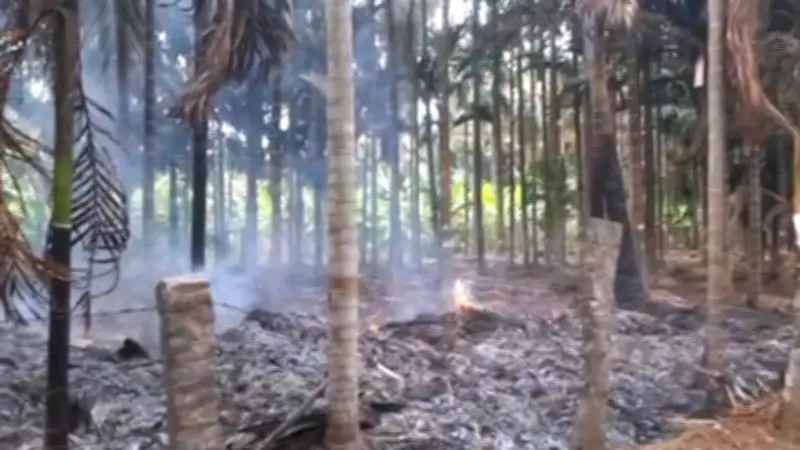
In a rare and astonishing meteorological event, a dry lightning strike in Chamarajanagar district of Karnataka destroyed approximately 40 trees in a matter of minutes. The incident occurred on Tuesday afternoon, leaving local residents and officials baffled. Unlike typical thunderstorms, this lightning was not accompanied by rain, making it an unusual phenomenon known as 'dry lightning'.
Details of the Incident
The lightning struck a cluster of trees in the forested area near the village of Kuderu, about 15 kilometers from Chamarajanagar town. Eyewitnesses reported seeing a bright flash followed by a loud thunderclap, but no rainfall. Within seconds, several trees were split or uprooted, with branches scattered across the ground. The affected trees included species such as teak and eucalyptus, which are common in the region.
Local Response and Investigation
Forest department officials rushed to the site after receiving reports from villagers. They assessed the damage and confirmed that 40 trees were completely destroyed, while many others sustained partial damage. 'We have never witnessed such an event before,' said a senior forest officer. 'Lightning usually occurs with rain, but this was different. We are investigating the cause.'

Local authorities have cordoned off the area to prevent accidents from falling branches or unstable trees. They have also advised residents to stay indoors during such weather conditions. The Karnataka State Natural Disaster Monitoring Centre has been alerted to study the phenomenon.
What is Dry Lightning?
Dry lightning is a weather phenomenon where lightning occurs without significant precipitation reaching the ground. It is more common in arid or semi-arid regions, where the air near the surface is dry. The lightning can ignite wildfires and cause damage to trees and structures. In this case, the lack of rain meant that the electrical discharge was not dissipated by moisture, leading to concentrated energy release.
Climate Change Link?
Experts suggest that such unusual weather events may be linked to climate change. Rising temperatures and changing weather patterns can lead to more frequent dry lightning events. 'While a single event cannot be directly attributed to climate change, it aligns with the trend of more extreme weather phenomena,' said a climatologist from the Indian Institute of Science.
The incident has sparked discussions about the need for better lightning detection and warning systems in rural areas. Farmers and villagers are particularly vulnerable, as they spend much of their time outdoors. The forest department plans to install lightning arrestors in vulnerable zones to mitigate future risks.