

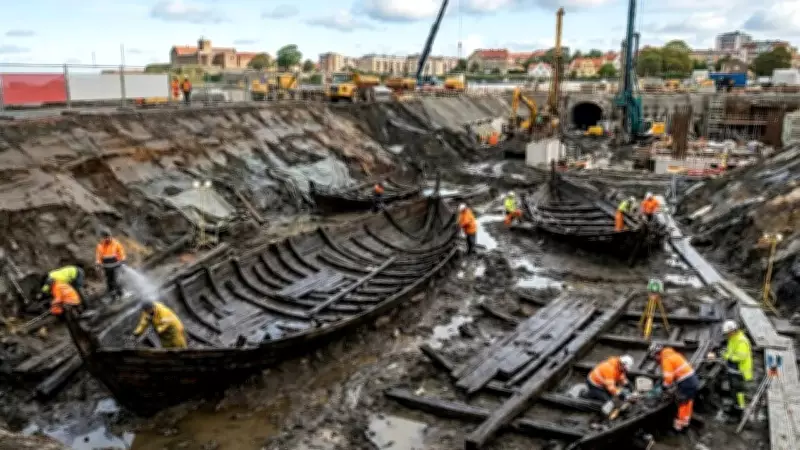
During the construction of a tunnel in Varberg, Sweden, as part of the West Coast Line expansion project, workers unearthed six shipwrecks that are reshaping the understanding of the region's history. Four of these wrecks date to the Middle Ages or Late Middle Ages, with two confirmed by experts from Arkeologerna, part of the National Historical Museums of Sweden. The findings include a medieval vessel and a 17th-century ship, with one wreck undated.
Insights into Nordic Trade and Shipbuilding
These artifacts provide evidence of how Nordic people traded and defended themselves over centuries, as well as the evolution of shipbuilding. The discoveries update the historical significance of Varberg, challenging previous records and offering new perspectives on Scandinavian maritime trade history since the early 20th century.
Evolution of Ship Design
According to a study by Arkeologerna, the six shipwrecks reveal the evolution of sailing vessels. Wreck 2 features traditional wooden clinker construction with overlapping planks, while Wreck 6 showcases the later carvel design with edge-aligned planks and a smooth finish, including Dutch-influenced grooves on the keel. These examples show how ships adapted to changing freight requirements and Baltic Sea conditions between 1600 and 1700, creating a material culture record of vessel design changes in response to trade patterns, environmental factors, and technological advancements.

Conflict Between Modern Infrastructure and History
The Bohuslän Museum, Visual Archaeology, and Cultural Environment Halland are collaborating to excavate the shipwrecks. However, the construction schedule for the new rail tunnel, intended for daily use, pressures the team to expedite excavation of Wrecks 5 and 6, potentially leaving parts of these historically significant vessels buried. The discovery highlights the ongoing conflict between preserving cultural heritage and modern urban development. The ongoing analysis will continue to provide insights into early medieval life, including trade routes and living conditions aboard these vessels.
Role of Trade Ships in Medieval Varberg's Economy
Beyond the 16th and 17th-century finds, archaeologists focus on Wrecks 3 and 4, identified as 14th-century 'koggs'—flat-bottomed trading ships. These vessels are critical for understanding medieval logistics. By examining timber and construction, researchers aim to map maritime trade networks that supported medieval Varberg and its neighbor, Ny Varberg. Comprehensive reports from Arkeologerna and partners will reconstruct the role these vessels played in the economic and cultural life of the Baltic coast, ensuring even fragmented remains contribute to the broader historical record.






