

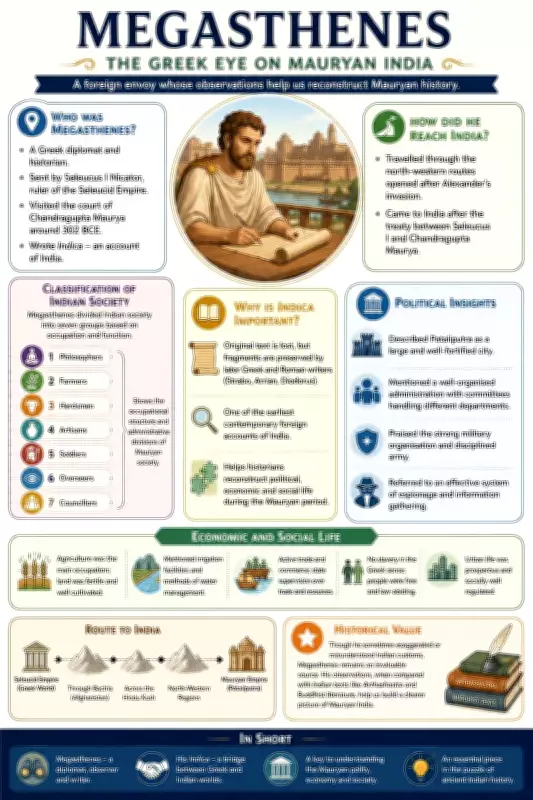
Megasthenes, a Greek ethnographer and diplomat, served as an ambassador to the court of Chandragupta Maurya in the 4th century BCE. His work, Indica, remains one of the most important foreign accounts of ancient Indian society, providing a unique glimpse into the Mauryan Empire's administration, culture, and daily life.
Who Was Megasthenes?
Megasthenes was born around 350 BCE in Asia Minor, likely in present-day Turkey. He was sent by Seleucus I Nicator, a successor of Alexander the Great, to the Mauryan capital Pataliputra (modern Patna). He spent several years at the court, observing and recording his experiences. His writings, though lost to time, survive in fragments quoted by later Greek and Roman authors such as Strabo, Arrian, and Diodorus Siculus.
Key Observations in Indica
Administration: Megasthenes described a highly centralized bureaucracy under Chandragupta, with a council of ministers overseeing various departments. He noted the existence of a postal system and a network of spies. The empire was divided into provinces, each governed by a viceroy, and the capital was fortified with wooden walls and 570 towers.

Society and Caste: He outlined seven social classes: philosophers, farmers, soldiers, herdsmen, artisans, magistrates, and councilors. While this classification differs from the traditional varna system, it reflects the functional divisions he observed. He praised the honesty of Indians and their lack of litigation.
Economy: Megasthenes recorded a prosperous agrarian economy with irrigation systems. He noted that farmers paid a portion of their produce as tax and that land was fertile, yielding two crops per year. Trade flourished, with gold and silver used as currency.
Culture: He described the simplicity of Indian life, with people wearing linen garments and adorning themselves with ivory and precious stones. He was impressed by the absence of slavery, the reverence for elephants, and the practice of polygamy among the elite.
Legacy and Criticism
While Megasthenes' account is invaluable, scholars caution against taking it at face value. Some descriptions, like the seven castes, may be oversimplifications or misinterpretations. Nonetheless, his work provides a rare external perspective on Mauryan India, complementing indigenous texts like the Arthashastra. His observations on the empire's efficiency and wealth influenced later Greek perceptions of India as a land of wonder.
In summary, Megasthenes stands as a bridge between the Hellenistic world and ancient India. His Indica remains a cornerstone for historians studying the Mauryan period, offering a vivid portrait of a civilization at its zenith.






