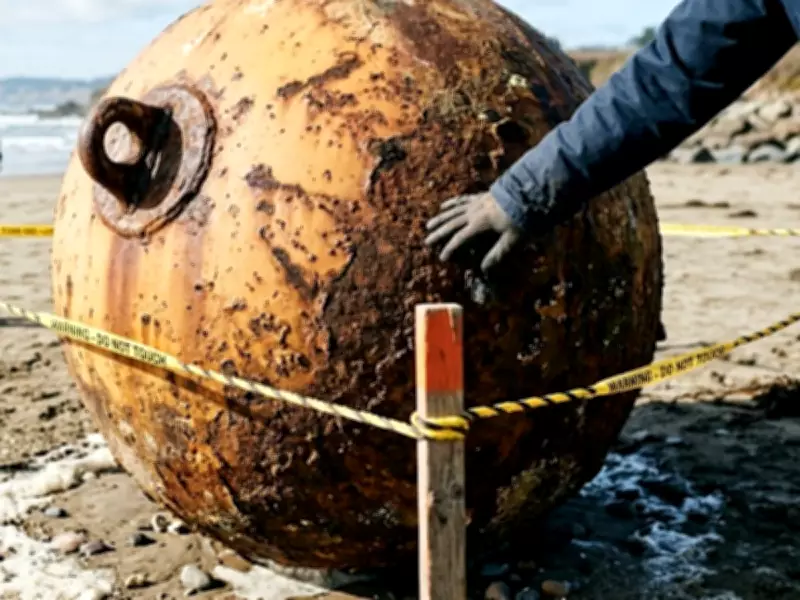
Imagine a tranquil, warm morning at a beach, with nothing but the gentle surf and an occasional seashell. But instead, you come across an enormous, dark metal sphere over four feet in diameter, half-submerged in sand. It sounds like the opening of a classic Hollywood sci-fi film, but this actually happened on Enshuhama Beach in Hamamatsu, Japan.
The strange discovery triggered an immediate emergency response. Security personnel quickly arrived as onlookers watched. Police donned heavy helmets and hazmat suits, sealing off the area. In a comical show of caution, they placed a single traffic cone on the beach to protect beachgoers from a potential blast radius.
Naturally, the internet exploded with theories. TikTok and X were flooded with rumors ranging from far-fetched to terrifying. Some speculated the sphere could be a giant egg from an undiscovered deep-sea creature. Many believed it was a sophisticated spy weapon. This collective panic did not go unnoticed in a time of heightened global anxiety.

To understand how a single piece of metal caused such a frenzy, consider the broader context. The incident occurred amid high worldwide tension. Generation Y and younger people in the US were following a series of military developments, particularly the US military's attack on a suspected Chinese spy balloon over American airspace. Add perpetual fears about North Korean missile tests in the Sea of Japan, and you have a recipe for an action thriller.
In a world consuming news via short digital clips, the line between marine debris and real danger blurred. Everything floating seemed like a monitoring instrument. Within days, many believed a piece of modern military equipment had been found on a Japanese beach.
After thorough X-ray examination, Japanese officials declared the sphere safe. Hiroyuki Yugi, an official from the Shizuoka Prefecture's River and Coastal Management Bureau, provided a grounded explanation: the object was solid steel and harmless. He added that the ball would be scrapped and recycled by a local business. Officials confirmed it was a harmless oceanographic buoy, highlighting how easily fear and misinformation spread.
Unglamorous Facts About Ocean Drifters
What did this fearful object actually do? According to oceanographers, it was simply an oceanographic buoy that had broken free from its anchor. While not as sleek as a spy device, these spheres are under-appreciated tools in marine science.
These buoys monitor environmental parameters across oceans. A study in Water highlights their role in tracking sea temperature, pH, and dissolved oxygen for coastal monitoring and ecological forecasting. When buoys fail, they create gaps in climate modeling.
Research in Frontiers in Marine Science notes that thousands of drifting buoys validate satellite data and track ocean currents. Over time, storms or rust can break their anchor chains, turning scientific instruments into drifting debris.
The Hamamatsu sphere was likely a mooring buoy for industrial or deep-sea research that floated across the Pacific for years until the tide brought it ashore. In the end, the incident didn't end with a flash but with a recycle bin. It is a humorous reminder that in an age of hyper-connected fear, a global threat can be just an errant piece of marine junk heading for a scrapyard.