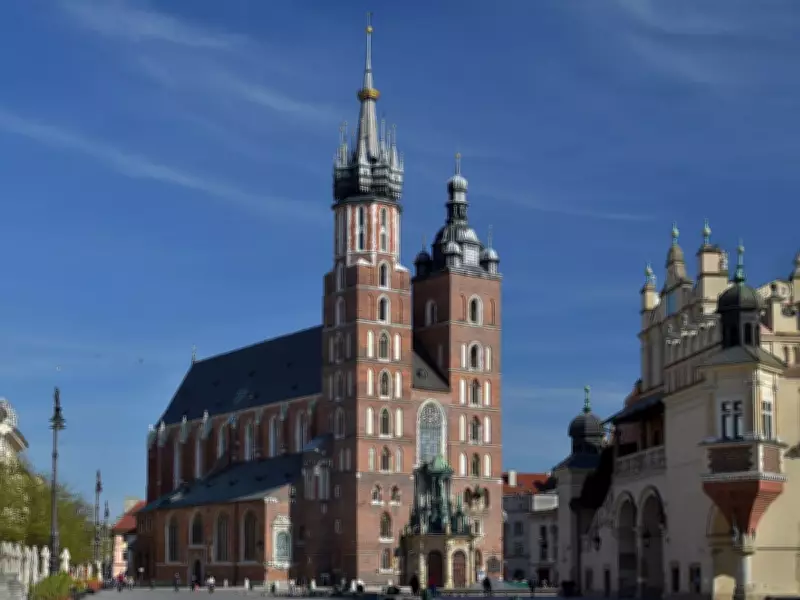
Mystery of Poland's Doorless Church Finally Solved
Imagine walking through the historical cobblestone ring of Krakow, Poland, and coming across a 2,000-year-old stone church. It is small, round, and remarkably preserved. However, as you stroll through its sandstone walls that have weathered, there is something that seems off. There is no entry point. A grand archway is not present, nor is a side door, and certainly no evidence of a doorway that was ever present at the ground. Over the years, the architectural ghost story about Wawel Hill has caused archaeologists to scratch their heads. How did people get into the building, which seemed to be sealed off?
Since its founding, the Church of the Holy Virgin Mary has been a major puzzle for historians. It was built in the 10th century and is one of the oldest stone structures in the nation. It is only 20 feet tall and still a silent wall guarded by a mystery that was believed to be impossible to solve. Some experts suggested that individuals may have used an old wooden ladder to reach an upper story, while others speculated about hidden underground tunnels or crypts. A new angle has finally shed light on this long-standing puzzle.
A Hidden Connection to Royalty
A groundbreaking study by Klaudia Stala, an associate professor and archaeologist from Krakow University of Technology, has revealed that we have looked at the church in a different way. Her research was released in the International Journal of Conservation Science. Stala suggests that the church was not designed to be an isolated entity. Instead of being a standalone place of worship, the rotunda could have been just a small piece of a more complex puzzle, namely the royal palace complex.

With the help of high-tech instruments such as ground-penetrating radar and thermal imaging, Stala was able to observe beneath the surface without affecting the site. She saw the remains of a massive rectangular structure situated in front of the church. The structure was attached to the walls of the rotunda, which suggests that the missing door was not missing in the first place. It was merely an internal entrance. In this way, the church was a private royal chapel. The royal court could walk directly from their residences to the church using an enclosed walkway. The layout could have eliminated any need for doors, thereby keeping the royal worship in the king's palace private and secure.
Debunking the Myth of the Second Floor
Before the finding, the oldest and most talked-about theories centered on a floating entryway. Historians believed that churchgoers used external stairs to access an entrance on the second level. Advocates of this notion pointed to the church's windows, which are sunk into the ground, suggesting that the present-day ground was previously much higher. They proposed that a buried first floor, or crypt, could have existed beneath.
Stala's research, however, disproves this belief. Thermal imaging did not indicate a hidden crypt or even a buried lower level. Additionally, she highlighted an architectural fact that most had missed. The wall of the rotunda's turrets comprises light slabs of sandstone held together by cement-based mortar. The walls of the rotunda were too weak to support the load of a massive second story or the strain of an enormous exterior staircase.
In comparing the Krakow rotunda with other small circular churches found in Croatia and Italy, Stala showed that low-set windows were a common architectural style of the period and do not necessarily indicate a buried floor. The irregularities found in ground-penetrating radar scans perfectly align with the outline of other medieval Polish palaces, like the royal compound recently discovered in Poznan.
Implications of the Discovery
The discovery alters the way we think about early Polish history. It provides a glimpse of the sophisticated lifestyle of a royal family that used architecture to create seamless, intimate passages between home and holy. The mystery surrounding the doorless church reminds us that often, the solution to a puzzle is not always found by examining what is missing, but instead by looking at what was there. The church did not need doors to the world, as it was already part of a house.