

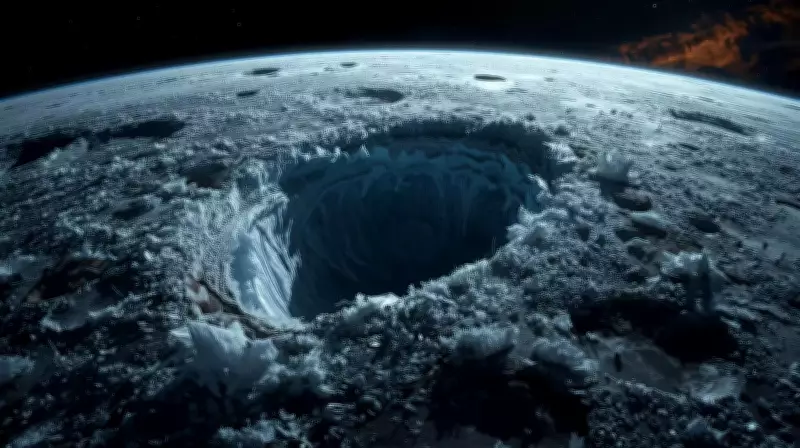
NASA's Juno Spacecraft Provides Unprecedented View Beneath Europa's Frozen Surface
New measurements from NASA's Juno spacecraft have delivered groundbreaking insights into the mysterious subsurface of Jupiter's moon Europa. During a close flyby in 2022, Juno collected microwave data that enabled scientists to probe the moon's icy crust to depths never before achieved, offering a clearer picture of what lies beneath the frozen exterior.
Decades of Uncertainty Finally Narrowed
For years, scientific estimates of Europa's ice shell thickness varied dramatically, ranging from just a few kilometers to several tens of kilometers with little consensus. The new analysis from Juno's data suggests the ice shell in the observed region is approximately 29 kilometers thick, significantly narrowing this long-standing uncertainty. Europa has captivated planetary scientists for over forty years due to compelling evidence pointing to a vast salty ocean beneath its icy surface.
Why Ice Thickness Matters for Understanding Europa
Understanding the structure above Europa's subsurface ocean is crucial because ice thickness fundamentally shapes several key processes:

- Heat movement through the icy crust
- Formation of cracks and fractures in the surface
- Potential material transport between the surface and the hidden ocean below
These factors directly influence Europa's potential habitability and the possibility of life existing in its subsurface waters.
An Instrument Designed for Jupiter Proves Revolutionary for Europa
The breakthrough came from an instrument not originally designed with Europa in mind. Juno's microwave radiometer was built to study Jupiter's deep atmosphere by measuring thermal emissions at different frequencies, each probing a different depth. During the Europa flyby, this instrument captured signals from just a few meters below the surface down to several kilometers deep.
By analyzing how brightness changed with frequency, scientists could infer temperature variations and reflections within the ice structure, creating the most detailed subsurface profile of Europa ever obtained.
Thick But Not Uniform: Europa's Complex Ice Structure
The data best fits a model of a conductive ice shell around 29 kilometers thick, with an uncertainty margin of approximately 10 kilometers. Importantly, this thickness applies specifically to the region Juno observed and may not represent the entire moon's ice shell.
The measurements also revealed small-scale structures within the ice, including cracks, pores, or other discontinuities extending a few hundred meters below the surface. These features appear limited in size—likely centimeters in scale—and do not penetrate deep enough to reach the ocean below.
Tempering Expectations About Surface-to-Ocean Connections
For years, Europa's dramatic surface fractures raised hopes that material from the surface could reach the ocean below, potentially carrying oxygen and other compounds that might feed potential life forms. The new results temper this optimistic scenario.
While shallow scatterers are present in the ice, they seem limited in both depth and volume. On their own, these features are unlikely to serve as long-lasting pathways between the surface and the subsurface sea. This finding doesn't rule out deeper fractures elsewhere on Europa but does narrow what scientists can infer from surface patterns alone.
The Salinity Factor: A Slight Adjustment to the Picture
The primary model assumes mostly pure water ice, but Europa's ice is probably salty due to interaction with the subsurface ocean. When salinity is included in calculations, the estimated thickness decreases by approximately five kilometers. This adjustment falls within the uncertainty range, suggesting that while chemistry matters for precise measurements, it doesn't overturn the broader conclusion about Europa's thick ice shell.
The shell remains substantial enough to insulate the ocean effectively, even if its upper layers prove more complex than previously assumed.

The Scientific Power of Ruling Out Possibilities
One of the study's quiet strengths lies in what it excludes from consideration. Very thin ice shells, once proposed to explain Europa's chaotic surface terrain, become harder to support with these new measurements. Simultaneously, extremely thick shells with minimal internal structure also struggle to match the collected data.
The result positions Europa's reality between these extremes—not simplifying the moon's complexity but constraining it within more defined parameters.
Implications for Future Exploration Missions
NASA's upcoming Europa Clipper mission, scheduled to focus directly on assessing the moon's habitability, will benefit significantly from these findings. Knowing the likely thickness of Europa's ice shell helps shape scientific expectations and allows mission planners to:
- Tune instruments for optimal data collection
- Refine models of Europa's subsurface structure
- Develop more accurate hypotheses about potential habitability
Although Juno's flyby covered only part of Europa, it provides a crucial reference point for future exploration. Europa remains a layered, fractured, and profoundly cold world with its ocean still hidden from direct observation. The ice above it, now measured more carefully than ever before, appears less mysterious but no less important to understanding this fascinating Jovian moon.
The findings from this groundbreaking study were published in the prestigious journal Nature Astronomy, marking a significant advancement in our understanding of one of the solar system's most intriguing ocean worlds.





