

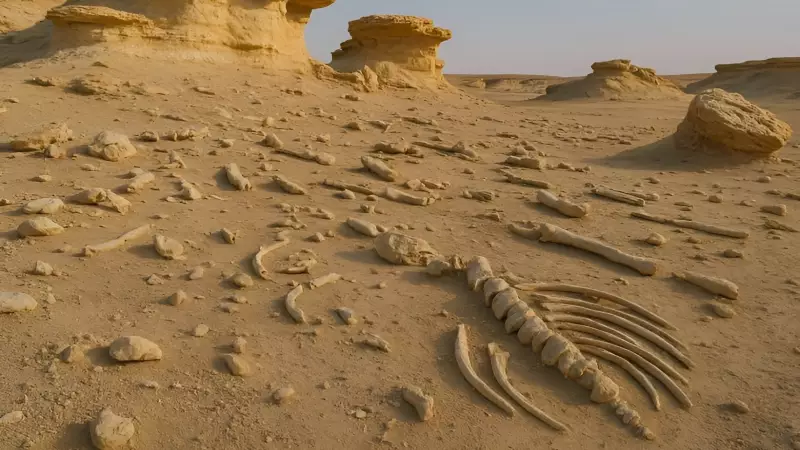
In a remarkable paleontological breakthrough, researchers have identified a previously unknown species of sea cow from a 21-million-year-old fossil bed in the Qatari desert. The discovery was made in the Al Maszhabiya region, an area once dubbed the 'Dugong Cemetery' by local experts.
Unearthing a Prehistoric Graveyard
The story begins roughly five decades ago when geologists first surveyed the vast, sandy expanse of southwestern Qatar. They encountered a startling sight: hundreds of bones scattered across the desert. Initially, these remains were thought to belong to ancient reptiles, a common find in such arid landscapes.
The mystery deepened in the early 2000s when a collaborative team from the Smithsonian Institution and Qatar Museums decided to re-examine the site. Ferhan Sakal, an archaeologist and head of excavation at Qatar Museums, recalled the site's nickname. "The area was called 'dugong cemetery' among our team," Sakal said, "but we had no idea just how rich and vast the bonebed actually was."

A Treasure Trove of Marine Fossils
The renewed investigation revealed the site's true significance. It is a massive, 21-million-year-old bonebed containing a stunning array of marine life fossils. Scientists identified more than 170 fossil-rich spots, cementing its status as one of the world's richest marine fossil deposits. Some experts have compared its importance to Chile's renowned Whale Hill.
The fossil assemblage includes remains of:
- Ancient sea cows (sirenians)
- Sharks
- Barracuda-like fish
- Prehistoric dolphins
- Sea turtles
This mix indicates that the modern Qatari desert was once a shallow, life-teeming sea. The rock layers preserve a long history of environmental shifts, offering scientists crucial data to predict how current marine ecosystems might react to warming waters, rising salinity, and pollution.
Introducing Salwasiren qatarensis
The latest finding, recently published in the journal PeerJ, is the crown jewel of this research: a new species of sea cow named Salwasiren qatarensis, after Qatar. While resembling modern dugongs that still inhabit waters just 10 miles away, this ancient creature had distinct features.
Key differences from modern dugongs include:
- A smaller body size
- A straighter snout
- Shorter tusks
- The retention of hind-limb bones, which modern sea cows have lost through evolution
Researchers believe Salwasiren played an ecological role similar to today's dugongs, grazing on seagrass and helping maintain a healthy marine environment. This connection underscores a poignant contrast: while the Arabian Gulf now hosts the world's largest dugong herd, their seagrass habitats—and thus their future—are under severe threat.
The discovery of Salwasiren qatarensis not only adds a new branch to the tree of life but also provides a vital window into the past, helping scientists understand and potentially safeguard the marine ecosystems of the future.






