

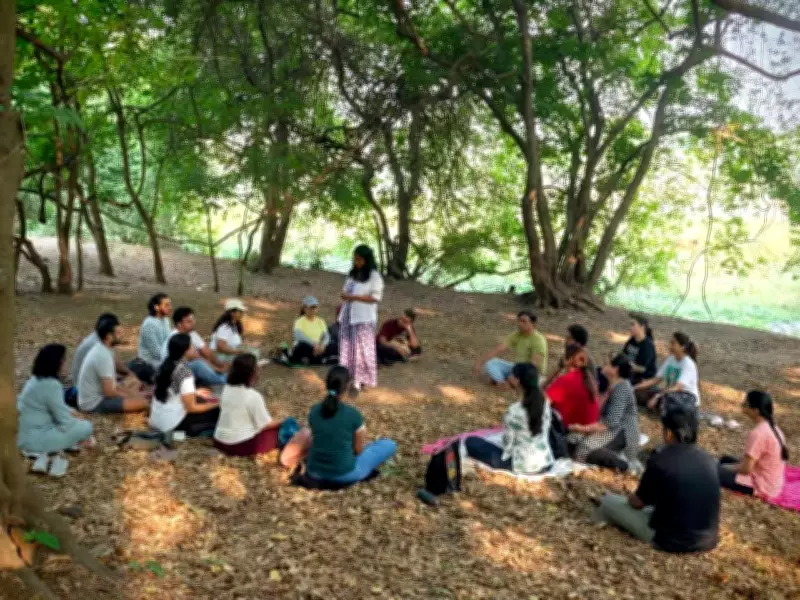
In Pune, the birthplace of the Maratha Empire, environmental advocacy often follows familiar, high-stakes paths: fierce protests, formal letters, massive campaigns, and litigations. Yet, the city's activism extends beyond confrontation. The cultural capital of Maharashtra is home to a quieter revolution, where residents are invited to pause and notice—to linger beside a riparian tree, learn the name of a local bird, or watch a spider spin its web. The hope is that if citizens learn to care for small things, they will naturally defend larger ones when needed.
Spider Walks and New Discoveries
Atharva Kulkarni, 25, a "spidey" enthusiast with an MSc in environmental science, used to share his passion for eight-legged creatures only with close friends. In 2024, he held his first public walk with Jeevitnadi, an environmental non-profit. "Fourteen people came. Since then, I have been conducting these walks seasonally," Kulkarni says. "The idea is to help people understand how vital spiders are to the ecosystem." Two years ago, his dedication led him to discover a new species of jumping spider on a city hill, which he named Okinawicius tekdi.
Kulkarni explains, "Spiders are natural pest controllers. They are a crucial protein source for birds, and none of our Indian spiders are invasive. While conservation usually focuses on large animals, it is equally important to save 'unglamorous' species. I want people to appreciate them and understand why saving green spaces is important."

Bird Walks and Community Engagement
Kedar Champhekar, a biodiversity expert and nature educator, conducts bird walks to turn casual observers into active conservationists. "I started a bird walk at Empress Garden in 2019 to show people the space is more than a picnic spot," Champhekar said. "Later, I began walks on hills for the Ecological Society. People are genuinely hungry to know more about nature. Some participants become so involved that when it's time to send petitions or join a protest, they show up on their own."
These walks have expanded to Pimpri Chinchwad and surrounding areas, supported by trained volunteers. "Everyone has a day job, yet they take time out. The birding community in Pune has grown significantly, with many youngsters attending," Champhekar added.
Soft Engagement After the Chipko March
This "soft" engagement became vital after February 2025, when hundreds participated in a "Chipko march" to protest riverfront development projects. Organisers began holding regular cultural and educational events to sustain momentum. "Broadly, we have three types of programmes: cultural events and walks, tree mapping, and biodiversity mapping," said Ajay Homkar, an MNC employee who dedicates weekends to saving Pune's green cover. "We host musical ragas related to forests, nature poetry sessions, and mobile photography workshops. Groups are kept under 25 people to avoid disturbing flora and fauna. Many who came out of curiosity are now our most active volunteers."
Homkar recalled, "My son is a birder, and during the pandemic, we started visiting the riverbank. One day, I saw trees numbered for felling and realised this oasis would be destroyed. The more I questioned, the more I got involved. It's the same for others: the more you know, the more you learn, and the more you want to take responsibility."






