

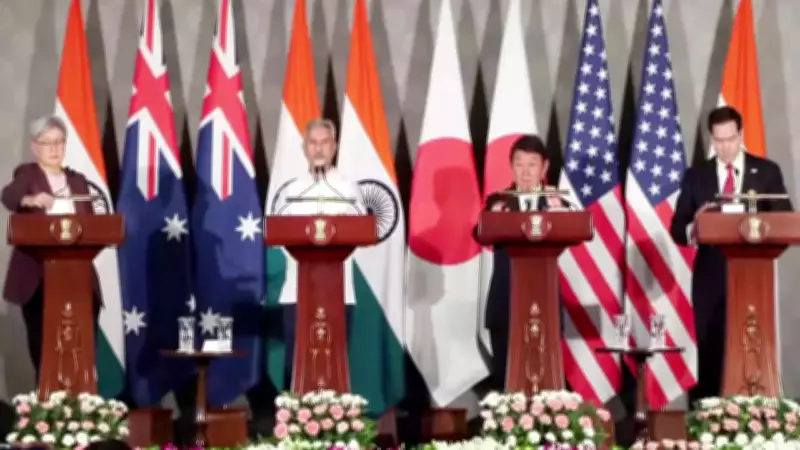
The Quadrilateral Security Dialogue (Quad) on Tuesday unveiled a new Indo-Pacific energy security framework designed to address supply disruptions through strategic fuel reserves, coordinated emergency response mechanisms, and targeted policy initiatives. This development comes amid growing concerns over instability in global energy supply chains.
Quad Foreign Ministers Meeting
The announcement followed the Quad foreign ministers' meeting in New Delhi, chaired by Indian External Affairs Minister S Jaishankar and attended by US Secretary of State Marco Rubio, Australian Foreign Minister Penny Wong, and Japanese Foreign Minister Toshimitsu Motegi.
The initiative is driven by rising global worries over disruptions linked to the blockade of the Strait of Hormuz, a critical maritime route through which nearly one-fifth of the world's oil and liquefied natural gas supplies pass.

Joint Statement Highlights
In a joint statement, the Quad nations reiterated the importance of ensuring unimpeded freedom of navigation and uninterrupted flow of global commerce, including in the Strait of Hormuz, while opposing any restrictive measures that hamper commercial shipping. The grouping stressed the need for well-functioning, stable, transparent, secure, and resilient energy markets and highlighted the importance of diversified and resilient supply chains.
Quad Initiative on Indo-Pacific Energy Security
Under the new framework, the Quad countries will collaborate to identify areas of cooperation in technology, policy coordination, international market analysis, and emergency response exercises through a dedicated engagement plan. An official readout stated that the initiative would seek to recognize and leverage the unique resources and capabilities of each country's energy sector, including strengthening strategic petroleum reserve systems. The Quad also committed to working with Indo-Pacific partners to improve regional energy resilience.
Ministerial Remarks
Addressing the media after the meeting, Jaishankar said the four countries strongly believed in promoting economic resilience and strengthening supply chains. Our deliberations touched on the current energy and fertilizer availability as well as that of critical minerals and resources. The goal is to intensify cooperation amongst ourselves, while also assisting others, he said. In the coming days, whether it is economic activity, energy trade or maritime commerce, the Indo-Pacific will become even more important to the world, the minister added.
Maritime Security and Critical Minerals
The meeting also focused on maritime surveillance, critical minerals, and infrastructure cooperation across the Indo-Pacific region. According to MEA Additional Secretary Nagaraj Naidu, the Quad launched the Indo-Pacific Maritime Surveillance Collaboration (IPMSC), aimed at enhancing coordination in maritime surveillance and improving real-time vessel tracking in the Indian Ocean region.
The ministers also announced the Quad Critical Minerals Initiative framework to strengthen cooperation in mining, processing, recycling, and investment across trusted supply chains critical for advanced manufacturing and emerging technologies.
Counter-Terrorism and Infrastructure
On counter-terrorism, the Quad foreign ministers strongly condemned terrorism in all forms, including cross-border terrorism. The joint statement specifically condemned the April 2025 terror attack in Pahalgam and called for decisive global action against terror entities and sponsors. The grouping further reaffirmed support for trusted infrastructure projects, including a joint port infrastructure pilot project in Fiji, while also discussing cooperation in artificial intelligence, semiconductors, 5G and 6G technologies, digital standards, and undersea cable connectivity across the Indo-Pacific.






