Russia Launches Massive Overnight Missile Strikes on Ukraine
Russia on Sunday carried out a series of overnight missile strikes on Ukraine, employing four distinct types of missiles, including the advanced hypersonic Oreshnik. Moscow described the attacks as retaliation for what it claimed were Ukrainian strikes on civilian targets within Russian territory. According to Russian state news agencies, the missiles used included the Oreshnik, Iskander, Kinzhal, and Zircon systems.
Russian Defense Ministry Claims Success
Interfax quoted the Russian Defence Ministry as stating that the strikes targeted Ukrainian military command facilities, air bases, and enterprises associated with Ukraine's military industrial complex. Moscow asserted that all strikes were successful. However, Reuters noted that it could not independently verify these battlefield reports.
Zelenskyy Confirms Use of Hypersonic Oreshnik
Ukrainian President Volodymyr Zelenskyy confirmed that Russia deployed the hypersonic Oreshnik ballistic missile during the mass overnight assault on Kyiv. In a Telegram post, Zelenskyy reported that the missile struck the city of Bila Tserkva in the Kyiv region, though the intended target remains unclear. The overnight attack involved 600 strike drones and 90 air, sea, and ground-launched missiles, according to Ukraine's Air Force.

Ukrainian Air Defenses Respond
Ukraine's Air Force reported that its air defenses destroyed or jammed 549 drones and 55 missiles, while approximately 19 missiles failed to reach their targets. One medium-range ballistic missile was launched from Russia's Kasputin Yar site in the Astrakhan region, known as the launch site for the Oreshnik missile. The Air Force did not officially confirm the missile's use but had earlier warned of a possible launch.
Casualties and Damage
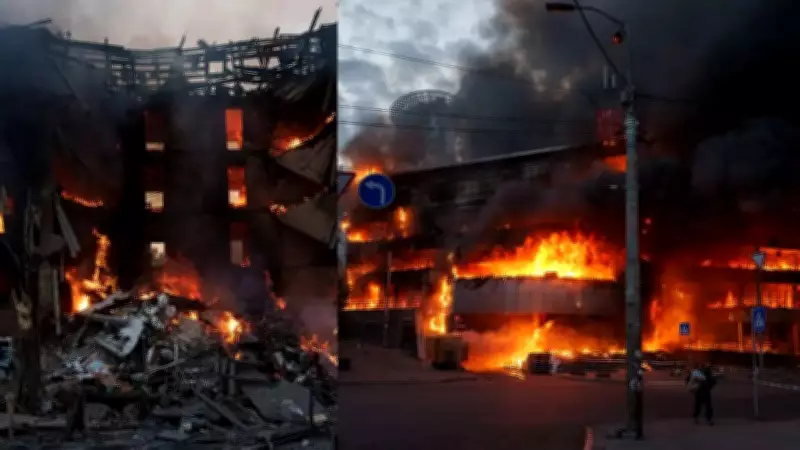
At least two people were killed and 56 others injured in the strikes, according to preliminary figures from local authorities. Explosions were heard near government buildings in central Kyiv, with damage reported at 40 locations across multiple districts, including residential buildings, schools, supermarkets, and warehouses.
Eyewitness Accounts
Kyiv resident Svitlana Onofryichuk, 55, whose workplace was damaged, described the attack: 'It was a terrible night, and there had never been anything like it in the entire war. I am very sorry that I have to say goodbye to Kyiv now, I am not staying there anymore, there is no possibility. My job is gone, everything is gone, everything has burned down.'
Another resident, 74-year-old Yevhen Zosin, recounted the moment of impact: 'Then there was another explosion and she and I were thrown back like a pin by the shock wave. We both survived, she and I. My apartment was blown to pieces.'
Damage to Infrastructure
In Kyiv's Shevchenko district, a five-story residential building caught fire after being hit, killing one person, according to Ukraine's state emergency service. Mayor Vitalii Klitschko stated that a school building was also damaged while civilians were sheltering inside.
Background on Oreshnik Missile
Russia first used the multiple-warhead Oreshnik missile against the Ukrainian city of Dnipro in November 2024, followed by another strike in the western Lviv region in January. Russian President Vladimir Putin has previously claimed that the Oreshnik missile travels at 10 times the speed of sound and can penetrate underground bunkers 'three, four or more floors down.' Putin also asserted that the weapon is immune to missile defense systems and that several such missiles armed with conventional warheads could be as devastating as a nuclear strike.