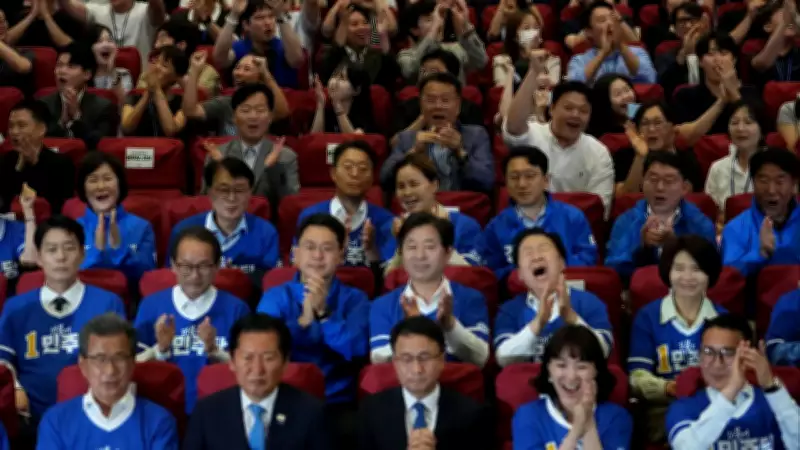
South Korea's ruling liberal Democratic Party secured a majority of races in Wednesday's local elections but suffered a significant setback by losing the crucial Seoul mayoral contest, undermining efforts to strengthen President Lee Jae Myung's political mandate.
Lee's Democratic Party had been widely expected to claim several of the contests because its main rival, the conservative People Power Party (PPP), remains in disarray after President Yoon Suk Yeol was removed from office and sentenced to life in prison over his martial law debacle in late 2024. However, experts noted that given the favorable political landscape, the Democratic Party should have won the most crucial race—the Seoul mayoralty—to claim an outright victory in the elections.
Election Results
With almost all votes counted by Thursday morning, the Democratic Party won 12 of the 16 mayoral and provincial gubernatorial posts up for grabs. The PPP won four, including the Seoul mayoral race. Democratic Party leader Jung Chung-rae told reporters that his party's defeat in the Seoul race was "painful," though he thanked voters for the wins in other races.

Importance of Local Leadership Posts for Lee
Thursday marked one year in office for Lee, who won a snap election triggered after Yoon's ouster. Lee's approval ratings still exceed 60%. He has been credited with what he calls "pragmatic diplomacy" that eased concerns his presidency would hurt ties with the U.S. and Japan. His popularity has also been attributed to a booming stock market and efforts to be more transparent about government decision-making procedures. Lee's foreign policy agenda will likely remain unchanged. The Democratic Party also boosted its parliamentary majority by winning nine of the 14 parliamentary byelections on Wednesday.
However, having more allies at mayoral and gubernatorial posts will be essential to Lee's governance, especially since the PPP holds 14 of the 16 regional leadership posts currently. Lee could pursue regional policies more easily and effectively, which will help his party's preparations for the 2028 parliamentary elections, said Choi Jin, director of the Seoul-based Institute of Presidential Leadership.
Focus on Seoul's Mayoral Race
Exit polls and early results had shown Democratic Party candidate Chong Won-o ahead of current Mayor Oh Se-hoon in the Seoul race. But the PPP's Oh dramatically overtook Chong by Thursday morning as more votes were counted. "Seoul's future has become brighter," Oh said in an acceptance speech. "Our citizens ensured that the Republic of Korea does not tilt excessively toward one direction and preserved Seoul as democracy's last safeguard." In a separate news conference, Chong conceded defeat, saying he "heavily and humbly" accepts the result.
Their race triggered brief, severe disputes Wednesday night after the election commission announced a shortage of ballot papers in some polling stations in Seoul caused a temporary suspension of voting there. PPP leader Jang Dong-hyeok said the incident seriously hurt voters' rights to cast their ballots, demanding authorities hold a new election depending on investigation results. The Democratic Party flatly rejected the PPP's demands, saying they were "not even worth considering."
Election Results Crucial for the Conservative Opposition
The PPP is still struggling with internal feuding between reformists who joined the Democratic Party-led push to impeach Yoon and his loyalists who attempted to protect the embattled leader. Among the candidates who won the parliamentary by-elections was Han Dong-hoon, leader of the reformist faction who was eventually expelled from the PPP. Han, now an independent, beat the Democratic Party's Ha Jung-woo, a former Lee adviser on artificial intelligence, in Busan, the country's second biggest city.
Jeong Han-Wool, director of the Korean People Research Institute, said that a Han victory could help anti-Yoon reformists regroup and emerge as a new force among the struggling conservatives in South Korea. But Choi, the institute head, said Han's win could worsen a divide in the conservatives because Yoon loyalists would feel a sense of crisis and close ranks further.