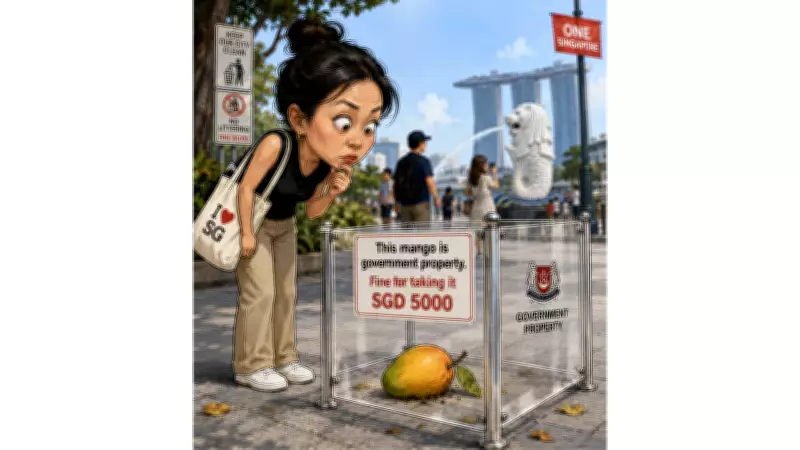
A fallen mango from a public tree in Singapore could reportedly lead to a fine of up to SGD5,000 (approximately ₹3.5 lakh), a fact that recently stunned Indian social media users. The discussion began after Priyanka Sinha, an Indian-origin Singapore resident, posted on X that fruit-bearing trees in public spaces are considered government property, meaning residents cannot pluck or collect fruits without permission.
Official Regulations on Public Trees
The Ministry of National Development (MND) Trees website states: “Trees, including their fruit, which are located on State land belong to the State. NParks manages most of the trees on State land. Members of the public who wish to pluck fruit from trees, or collect fruit that has dropped from trees on State land should approach NParks for permission. Those who pluck or collect fruit in a public park without permission can be fined up to $5,000 under the Parks and Trees Act. Those who do so in a nature reserve or a national park can be fined up to $50,000, and/or imprisoned for up to 6 months.”
Reactions from Indian Social Media Users
The internet, naturally, had jokes ready. Many online users compared the situation to India, where roadside fruit trees are often freely accessed by locals. While some joked that such a rule would be impossible to enforce in India, others said it reflected Singapore’s strict civic discipline. One user cheekily asked, “What if our pet animals can help to collect?” Another quickly replied, “In Singapore, pets are treated as an extension of the owner. If your pet collects fruit from a public tree, you are legally considered to have ‘caused or permitted’ the act.”

Broader Implications
This incident highlights the cultural differences in public property management between Singapore and India. In Singapore, strict laws ensure that public assets are preserved and managed by authorities, whereas in India, community access to natural resources like fruit trees is more common. The fine, which can be as high as SGD50,000 in protected areas, underscores the seriousness with which Singapore treats its public spaces. Social media users continue to debate whether such stringent rules are necessary for maintaining order or whether they infringe on individual freedoms.