

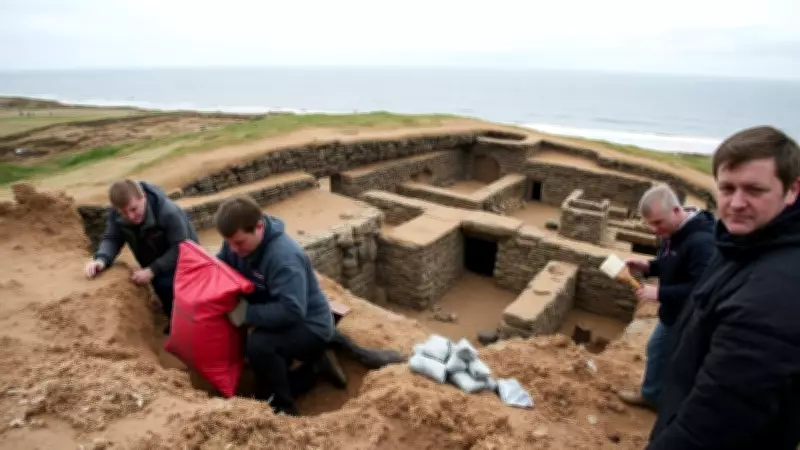
Some of the greatest discoveries begin not in libraries or laboratories but in the atmosphere. During the winter of 1850, a massive storm struck the west coast of Mainland in Orkney. It was so destructive that nature seemed intent on stripping the place bare. Yet, once the storm passed and the clouds cleared over the Bay of Skaill, the people found not only a ravaged shore but also a civilization that had vanished for five millennia.
William Watt of Skaill accidentally discovered Skara Brae while examining the storm's destruction on a large mound covered with grass and sand. Unaware of the ancient ruins beneath, the exposed stonework revealed human craftsmanship, leaving him in awe of the remnants.
A Time Capsule Carved in Stone and Sea Air
This revelation is remarkable because most ancient ruins consist only of foundations and scattered materials. However, Skara Brae was preserved under a pile of sand like a time capsule. The sand protected eight homes, and when removed, small houses with low roofs and covered walkways appeared. Most strikingly, the furniture remained in place, exactly as its creators left it centuries ago.

According to Historic Environment Scotland, the village dates back to between 3180 BCE and 2500 BCE, making it older than the Great Pyramids of Giza. The inhabitants were part of a sophisticated society that built stone dressers for belongings, stone beds for sleeping, and central hearths to fend off the North Atlantic chill. This offers a humble yet profound insight into domestic life at the dawn of settled agriculture. Now a UNESCO World Heritage Site, Skara Brae faces new threats from the encroaching Atlantic Ocean and climate change.
Exploring the site feels like walking through a neighborhood abandoned overnight. The intimacy is undeniable. The organic roofs, made of whalebone and turf, are long gone, allowing visitors to peer inside from above, like looking into a Stone Age dollhouse.
Conserving a Global Heritage on a Fragile Coastline
Despite its antiquity, the village has achieved global acclaim as the core of the Heart of Neolithic Orkney, a UNESCO World Heritage Site. This area boasts a rich collection of prehistoric sites unmatched in Northern Europe, including enormous stone rings and a grandiose chambered tomb, suggesting Orkney was once a crossroads of ancient cultures.
Research and management documents from the UNESCO designation highlight Skara Brae's importance to understanding human development, providing the most complete picture of a Neolithic settlement in Europe. However, the very element that revealed the site also poses its greatest threat. The Atlantic Ocean continues to erode the coast, and climate change makes winter storms more unpredictable.
Conservationists wage an endless battle to protect the stone walls from time and ocean. Sea walls remain, and technology keeps a vigilant watch, but the struggle persists. Skara Brae exemplifies how natural forces shape history: discovered after a storm, it now contends with oceanic forces threatening its future.
A visit today brings an urgent adrenaline rush. It offers unique insight into how, despite millennia of change, the simple human desire for a home and hearth remains unchanged. All it took was one lucky storm in 1850 to bring this truth back to light.






