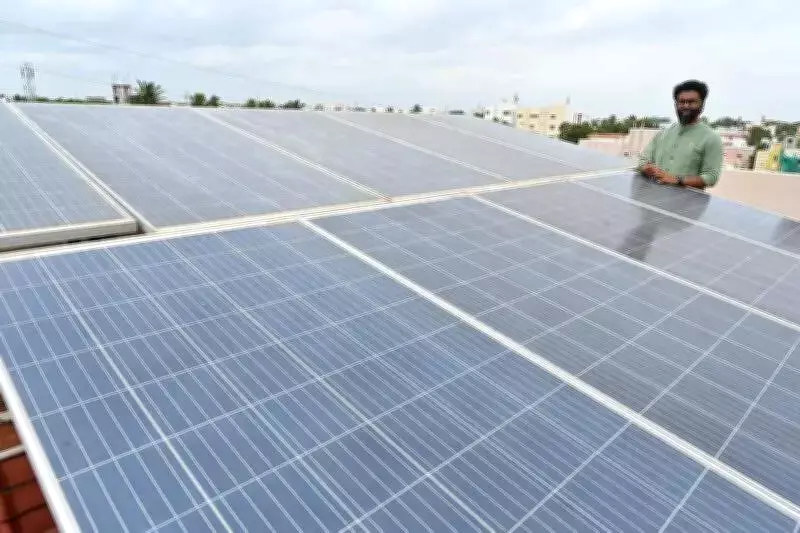
A new report has identified Tamil Nadu and Gujarat as potential models for India's clean energy transition, emphasizing the role of stronger industrial policy in attracting investments. The India's Climate and Energy Frontiers (ICEF) report, prepared by Schmidt Sciences in collaboration with the Indian Institute of Technology Madras and other leading national institutions, underscores the critical need for a well-formulated industrial policy to drive low-carbon growth.
Industrial Policy as a Catalyst
The report states that a robust industrial policy can create employment in sunrise sectors such as solar equipment manufacturing, battery storage, green hydrogen, and electric mobility. It notes that India has historically focused more on renewable energy deployment than on industrial development, resulting in heavy dependence on imports for clean energy components. For instance, India imports 80% of its solar module components and lithium-ion cells, primarily from China.
States like Tamil Nadu and Gujarat are leveraging industrial policy to attract clean energy investments, setting an example for the rest of the country. The report suggests that these states could serve as models for a national clean energy transition.

Land-Based Carbon Sequestration
Alongside clean energy expansion, the study highlights land-based carbon sequestration as a major pillar of India's decarbonisation pathway. India's forests, farms, and natural ecosystems already absorb nearly half a billion tonnes of carbon dioxide annually, equivalent to removing 113 million cars from roads. With improved monitoring, data systems, and coordinated research, this potential could increase by up to 400%.
Expert Insights
Professor Ashwin Mahalingam from the School of Sustainability at IIT Madras commented, "The report argues that climate and energy challenges can no longer be solved through isolated sectoral approaches. While scientific progress is advancing in areas such as clean energy, urban design, and environmental modelling, the ability to connect these advances is lagging."
Infrastructure Opportunity
The report also points out that about 90% of the infrastructure India will need for its near-term economic goals is yet to be built. This presents a once-in-a-generation opportunity to embed sustainability from the start, ensuring that new infrastructure is low-carbon and resilient.
The findings underscore the importance of coordinated action across states and sectors to achieve India's climate goals while fostering economic growth and employment.