Groundbreaking Discovery of Three New Lizard Species in Australian Savannas
In the sun-baked savanna regions of north-eastern Queensland, a team of dedicated scientists has announced the remarkable discovery of three never-before-documented lizard species, with the standout being the visually striking Orange-headed Rock Monitor. These fascinating reptiles, belonging to the Varanus family, have been officially named Varanus umbra, Varanus iridis, and Varanus phosphoros, marking them as Australia's first officially identified eastern savanna rock monitors.
Scientific Breakthrough Through Advanced Analysis
The groundbreaking study was led by Dr. Stephen Zozaya, a prominent scientist affiliated with the Australian National University. By employing sophisticated DNA sequencing techniques combined with meticulous morphometric analysis, the research team conclusively demonstrated that what was previously considered a single, adaptable group actually comprises distinct evolutionary lineages that diverged millions of years ago. The monitors' vibrant coloration and remarkable ability to cling to vertical cliff faces have captivated herpetologists worldwide.
"We were absolutely astonished when the initial genetic results came back," recalled Dr. Zozaya, reflecting on the fieldwork conducted in Queensland's rugged rocky outcrops. What appeared to be one flexible monitor species had fragmented into three clearly distinct ones: the Rainbow Rock Monitor (Varanus iridis), Orange-headed Rock Monitor (Varanus umbra), and Yellow-headed Rock Monitor (Varanus phosphoros). The comprehensive paper detailing these findings was published in the prestigious Zoological Journal of the Linnean Society in March 2026, integrating genomics, morphology, and ecological data.

Detailed Profiles of the Newly Discovered Species
Varanus umbra: The Orange-headed Rock Monitor
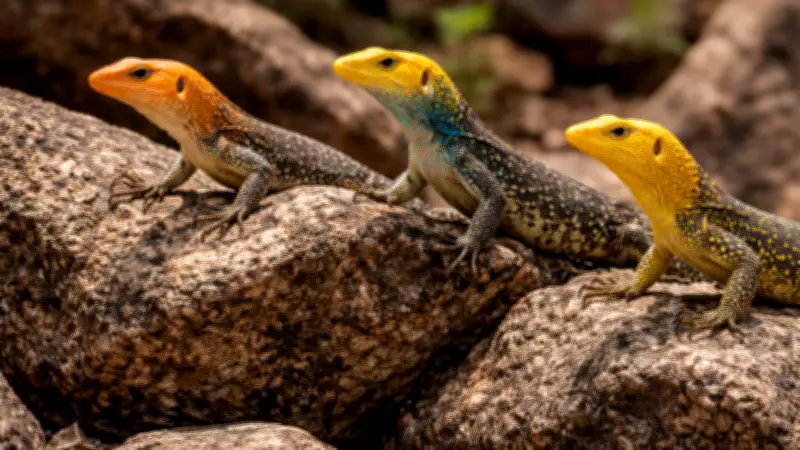
Enter Varanus umbra, the star species characterized by its smoky orange head that seamlessly blends into a speckled grey body. This slender lizard measures less than 137 millimeters in snout-vent length and 409 millimeters in total length, adeptly darting across sandstone plateaus within open woodland environments. Its tail provides crucial balance as it clings to sheer rock faces. "All three species names are related to light... to emphasize their beautiful and distinctive coloration," explained Dr. Zozaya. Perfectly adapted to life in rocky crevices, this monitor basks boldly in sunlight but disappears rapidly at the slightest disturbance, embodying the reptilian treasure trove hidden within eastern Australia.
Varanus iridis and Varanus phosphoros: Rainbow and Yellow-headed Varieties
Varanus iridis, the Rainbow Rock Monitor, displays a yellow head with an iridescent blue-green sheen on the nape, while Varanus phosphoros, the Yellow-headed Rock Monitor, glows with uniform yellow coloration against a grey-spotted body. Both species measure less than 168 millimeters in snout-vent length and are exceptionally agile rock-dwelling specialists. "These three species are more distinct from one another than many monitor species that have been recognized for decades," expressed an amazed Dr. Zozaya. Associated with scattered rocky outcrops, they skillfully avoid seasonal fires and floods that characterize the savanna landscape.
Evolutionary Significance and Ecological Insights
These discoveries fundamentally challenge existing theories about monitor lizard distribution patterns. While Australia's rock monitors were previously believed to be confined to western mountain ranges, the revelation that eastern species have occupied savanna regions demonstrates parallel evolutionary processes occurring in isolation. These dwarf monitors, part of the Odatria subgenus and distant relatives within the same genus as the formidable Komodo dragons, have inhabited cliff environments through ancient geological upheavals.

"The findings reshape our understanding of diversity within one of the world's most iconic lizard groups," stated Dr. Zozaya. From arid western regions to humid eastern landscapes, monitor lizards exhibit incredible adaptive capabilities, suggesting that Australia's biodiversity remains significantly under-explored and holds many more secrets waiting to be uncovered.
Habitat Characteristics and Conservation Concerns
Like isolated islands, rock outcrops scattered throughout Queensland's savannas provide essential refuge for these elusive goannas. They find shelter within rock crevices and scavenge for insects and small animals before vanishing at the first hint of danger. "These goannas are exceptionally difficult to locate and observe," admitted Dr. Zozaya, noting that citizen photographs have become invaluable for creating accurate survey maps. Significant knowledge gaps remain regarding their reproduction patterns, dietary preferences, and population sizes.
While some habitats exist in remote, hard-to-reach areas, accessible locations face increasing threats. PhD researcher Wesley Read warned about survey scars appearing on cap rock formations, while annual savanna fires present ongoing endurance tests for these reptiles. "Monitor lizards naturally attract attention... unfortunately, some individuals may cause damage to fragile cap-rock habitats. We have already witnessed such incidents," cautioned Read. Dangers include social media showcasing of captured specimens and potential poaching activities. "Even minor rock movements can render a shelter completely unusable," Read added.
Although their remote, rugged habitats have historically provided protection, these new species now face scrutiny from exotic pet collectors. "Increased survey efforts, including valuable reports from nature enthusiasts, will be crucial for their protection," urged Dr. Zozaya. The discovery of these lizard species highlights Australia's vast reptile unknowns, prompting urgent calls for protective measures within rapidly changing landscapes.
Collaborative Research and Future Prospects
The diverse research team, comprising scientists and field collaborators, found motivation in their shared enthusiasm. "We all drew energy from each other's passion... and that made this project particularly special," shared researcher Wesley Read. Northern Queensland's newly discovered lizards whisper a compelling message: more biological treasures await discovery within rocky cracks. For enthusiasts of reptilian biodiversity, this breakthrough represents pure scientific gold, opening new avenues for understanding Australia's unique ecological heritage.