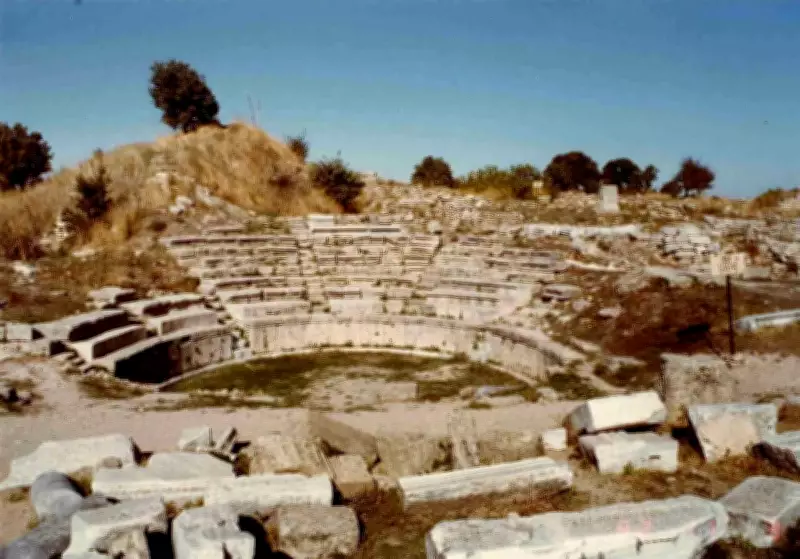
The idea of Troy evokes images of massive limestone walls, a decade-long war, and a giant wooden horse abandoned outside the city. This story of fire and bronze dates back nearly three thousand years. However, for archaeologists who have spent years deciphering the layers of earth at Hisarlik in Turkey, the reality is far more intricate and fascinating. Troy was not a single city but a series of settlements, built and rebuilt nine times over generations.
Beyond the Myth: A Vertical Timeline of Civilization
Popular myth suggests that Troy was a single site destroyed by a catastrophic battle. But the soil tells a different story. If we were to cut through the artificial hill today, we would not see a single war layer. Instead, we would observe the history of human civilization as a vertical timeline. Each successive generation constructed its settlement atop those of previous generations, eventually creating a hundred-foot-tall mound. This layered history is even more compelling than the legend. The fictional city was not merely a backdrop for poetry but an influential fortress that controlled the trade route from the Mediterranean to the Black Sea for 4,000 years. Tourists may be shocked to learn that Homer's Troy represents only a tiny fraction of this vast historical tapestry.
Peeling Back the Layers of an Ancient City
The transition from myth to science began in the 19th century when researchers realized that the mound of Hisarlik was man-made, not natural. As archaeologists excavated deeper, they moved back through millennia. The upper layers revealed remains of a Roman town with theaters and temples. Below that lay evidence of burnt Bronze Age fortresses, and finally, the crude stone structures of the first inhabitants. A definitive guide from the British Museum, titled The Search for the Lost City of Troy, explains that the site comprises nine major cities, labeled Troy I through Troy IX. Each level represents a distinct era, from the early Bronze Age around 3000 BC to the late Roman period. This layered reality means that when people ask, "Was Troy real?" the answer is a resounding yes, but one must specify which Troy they refer to. This layered history, spanning from the Bronze Age to the Roman period, underscores Troy's enduring significance as a strategic trade hub and a testament to human resilience, far beyond the mythological war.

According to the official UNESCO site for the Archaeological Site of Troy, this location is considered one of the most historically important in the world, offering an uninterrupted view of 4,000 years of history. The site provided the civilizations of Anatolia with an indispensable link to the rest of the Mediterranean world. Troy was not merely a war destination but a place of constant change, where culture survived long after the mythological "Trojan War."
Beyond the Wooden Horse: A City of Survivors
The key myth-busting point of modern archaeologists is not to disprove the Trojan War but to emphasize that Troy was not destroyed by the war and lived on for many years afterward. For a long time, specialists searched for a single layer showing clear signs of devastating fire and invasion. However, layers such as Troy VI and Troy VIIa, while showing damage from earthquakes or other conflicts, provide no definitive evidence of Troy's fate. Troy was resilient; it survived changes in weather patterns, shifting trade routes, and numerous sieges thanks to its strategic position. The mound was a natural fortress, and every time it fell, humans recognized its value and improved upon it. Many are surprised to learn that Troy continued to flourish into the Roman period, long after the days of mythological figures like Hector and Achilles.

The Significance of Troy Today
The significance of Troy today lies in its complexity. It is not just a place for literature enthusiasts to seek ghosts but a laboratory for understanding how ancient cities functioned. While Homer's Iliad gave Troy its name, archaeology has revealed the reality of Troy as an organic series of human aspirations. The TOI Science Desk, an inquisitive team of journalists, delves into the realms of discovery to curate captivating news, features, and articles from the ever-evolving world of science. They are committed to demystifying science, making it accessible and engaging for all readers. Join them as they craft knowledge with precision and passion, bringing you on a journey where the mysteries of the universe unfold with every word.