

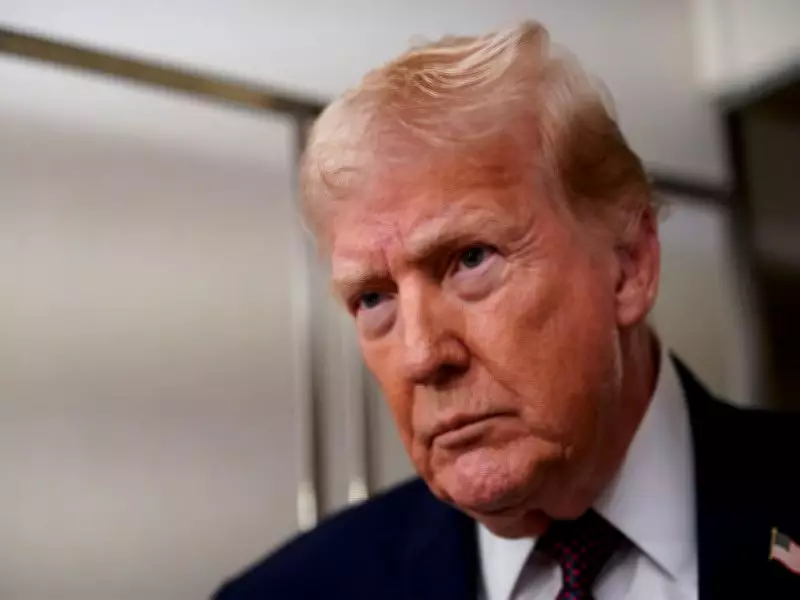
Former US President Donald Trump has stated that China did not challenge the United States naval blockade on Iran in the strategically vital Strait of Hormuz. In a recent interview, Trump asserted that Beijing refrained from confronting the US Navy's operations in the region, highlighting what he described as American military superiority.
Trump's Remarks on the Strait of Hormuz
Speaking to reporters, Trump claimed that during his administration, China avoided any direct confrontation with US forces enforcing a blockade against Iranian oil shipments. He said, "They wouldn't do that. They know we have the strongest military." The remarks come amid ongoing tensions between Washington and Tehran over Iran's nuclear program and regional influence.
Strategic Importance of the Strait
The Strait of Hormuz is a critical chokepoint for global oil supplies, with about 20% of the world's petroleum passing through it. The US has historically maintained a strong naval presence there to ensure freedom of navigation and to counter Iranian threats to maritime security. Trump's comments suggest that during his tenure, China, a major importer of Iranian oil, did not attempt to break the blockade, which aimed to cut off Iran's revenue streams.

Implications for US-China Relations
Analysts note that Trump's statement underscores the complex dynamics between the US, China, and Iran. While China has opposed unilateral US sanctions on Iran, it has generally avoided direct military confrontation with American forces. Beijing has instead pursued diplomatic channels and continued to purchase Iranian oil through alternative means, such as using non-dollar transactions and Chinese intermediaries.
Reactions from China and Iran
Chinese officials have not officially responded to Trump's claims. However, state-run media have previously criticized US sanctions as a violation of international law. Iran, meanwhile, has accused the US of piracy and has threatened to disrupt shipping in the Strait if its own exports are blocked. The Islamic Revolutionary Guard Corps has conducted drills in the area to demonstrate its ability to close the waterway.
Broader Context of US-Iran Tensions
The US naval blockade was part of a maximum pressure campaign launched by the Trump administration after withdrawing from the 2015 Iran nuclear deal. The policy aimed to reduce Iran's oil exports to zero, but it faced challenges as China and other nations continued to import Iranian crude. Trump's assertion that China did not challenge the blockade highlights the effectiveness of US deterrence during his presidency.
Current US President Joe Biden has pursued a different approach, seeking to revive the nuclear deal and ease some sanctions. However, negotiations have stalled, and Iran has accelerated its nuclear enrichment activities. The situation in the Strait of Hormuz remains tense, with occasional incidents involving US and Iranian vessels.
Expert Analysis
Security experts point out that while China may not have directly challenged the blockade, it has consistently opposed unilateral US sanctions. Beijing has also increased its naval presence in the region, including anti-piracy missions and port calls in Iran. Some analysts suggest that China's restraint is due to its reliance on the Strait for energy imports and its desire to avoid a direct conflict with the US.
In conclusion, Trump's remarks serve as a reminder of the high-stakes geopolitical maneuvering in the Persian Gulf. The Strait of Hormuz remains a flashpoint where the interests of global powers intersect, and any miscalculation could lead to a broader conflict. As the US and Iran continue to grapple over nuclear issues, the role of China as a balancing force will likely remain under scrutiny.






