

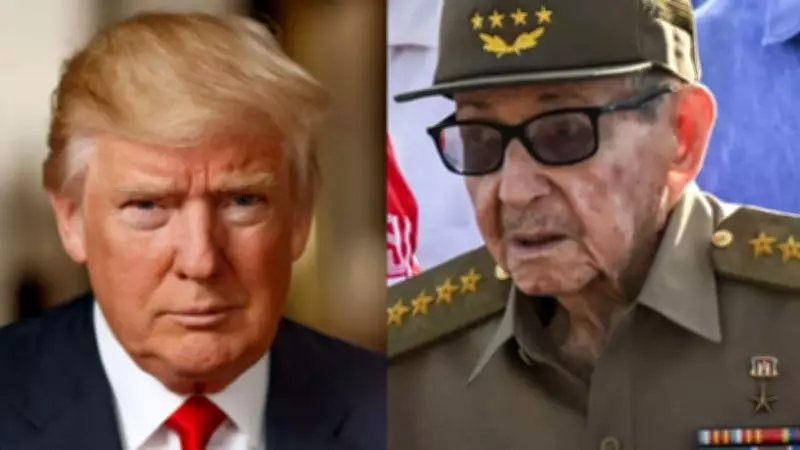
Donald Trump has downplayed concerns over escalating tensions with Cuba after the US Justice Department indicted former Cuban president Raúl Castro for the 1996 shooting down of civilian aircraft, insisting that there will be no escalation between the two countries.
When asked whether the indictment could trigger further confrontation, Trump responded: 'No. There won't be escalation. I don't think there needs to be. Look, the place is falling apart. It's a mess, and they've sort of lost control.'
The comments came after federal court records revealed that Castro, now 94, has been charged in the US with murder and related offenses for the downing of two civilian planes operated by the Cuban exile group Brothers to the Rescue nearly three decades ago.

The indictment was filed in Miami federal court on April 23 and unsealed this week. It accuses Castro of one count of conspiracy to kill US nationals, four counts of murder, and two counts of destruction of aircraft. Five other individuals are also named as defendants.
US acting Attorney General Todd Blanche announced the charges at an event in Miami, where officials gathered to honor the victims of the 1996 incident. He said, 'My message today is clear: The United States and President Trump does not and will not forget its citizens,' drawing applause from Cuban-American attendees.
Details of the 1996 Incident
The case centers on the shooting down of two small planes on February 24, 1996, when Cuban MiG fighter jets intercepted and destroyed aircraft flown by Brothers to the Rescue, a Miami-based exile organization that carried out missions over the Caribbean Sea to locate Cuban migrants attempting dangerous crossings. All four people on board were killed. The victims were Armando Alejandre, Carlos Alberto Costa, Mario Manuel de la Peña, and Pablo Morales.
The Cuban government has long maintained that the aircraft entered its airspace illegally, while US investigations and international aviation findings concluded that the planes were in international airspace when they were destroyed.
Former Cuban leader Fidel Castro previously said the military acted under 'standing orders' to intercept aircraft, but insisted no direct order was given by Raúl Castro, who was defense minister at the time.
Raúl Castro's Role and Background
Raúl Castro was born in 1931 and played a central role in Cuba's communist revolution alongside his brother Fidel, helping consolidate power after the 1959 overthrow of Fulgencio Batista. He served as defense minister for decades, later becoming president in 2008 before stepping down in 2018. He officially left the Communist Party leadership in 2021 but is still seen as an influential figure in Cuban politics.
US-Cuba Relations Under Trump
The indictment comes amid an escalation in US pressure on Havana under the Trump administration, which has combined sanctions and diplomatic pressure, calling Cuba a 'rogue state'. Trump has also framed US policy towards Cuba to expand influence in the Western Hemisphere, saying: 'From the shores of Havana to the banks of the Panama Canal, we will drive out the forces of lawlessness and crime and foreign encroachment.'
Cuban President Miguel Díaz-Canel has rejected US accusations, warning previously that any military action would lead to a 'bloodbath'. Tensions have been further complicated by Cuba's worsening economic crisis, with fuel shortages, blackouts, and food scarcity contributing to unrest on the island. Washington has increased sanctions on countries supplying fuel to Cuba, deepening the economic strain.






