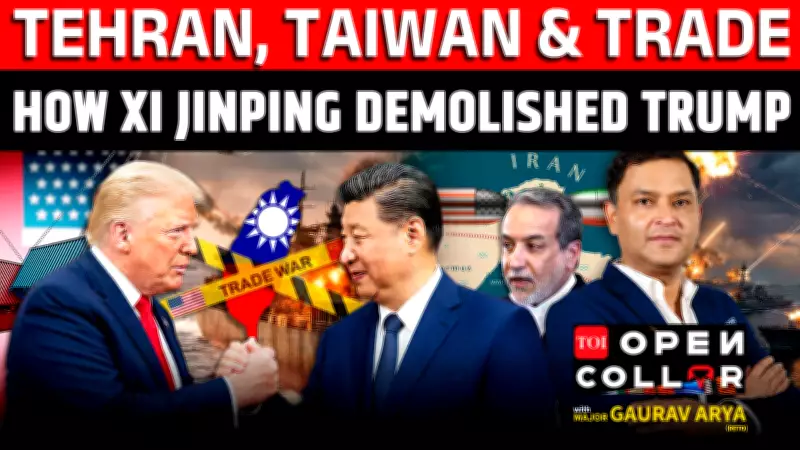
In this explosive episode of OPEN COLLAR, Major Gaurav Arya breaks down Donald Trump's high-stakes visit to Beijing and the shifting balance of global power between the United States and China. The episode explores why Trump appeared unusually conciliatory toward Xi Jinping, how the Iran conflict has strengthened Beijing's leverage over Washington, and why China now seems to hold the strategic advantage.
Key Insights from the Episode
Trump's Conciliatory Approach
Major Arya highlights that Trump's demeanor during the Beijing visit was markedly different from his usual aggressive stance. The former U.S. president seemed to tone down his rhetoric, signaling a possible recognition of China's growing influence. This shift raises questions about the underlying dynamics of the U.S.-China relationship.
Iran Conflict and Beijing's Leverage
The ongoing Iran conflict has inadvertently strengthened China's hand. As the U.S. becomes entangled in the Middle East, China has positioned itself as a key player, leveraging its economic and diplomatic ties with Tehran. This has given Beijing significant leverage over Washington, forcing the U.S. to seek cooperation on issues like oil prices and regional stability.

Strategic Advantage of China
China now appears to hold the strategic advantage in the global power balance. The episode examines how Beijing has capitalized on U.S. missteps, particularly in trade and military engagements, to solidify its position. China's control over rare earth exports and its influence over the Strait of Hormuz are critical factors in this shift.
Geopolitical Alignments and Tensions
China-Russia-Iran Axis
The growing alignment between China, Russia, and Iran is a central theme. This axis challenges the traditional U.S.-led order, with each country playing a complementary role. Russia provides military support, Iran offers regional influence, and China supplies economic backing. This trilateral partnership is reshaping global alliances.
Taiwan Tensions
The episode also touches on the Taiwan issue, where China's assertiveness continues to escalate. The U.S. faces a dilemma: defending Taiwan could lead to a direct confrontation with China, while inaction might embolden Beijing. China's strategic patience and military buildup in the region are key factors.
Trade Dependence and Rare Earths
America's trade dependence on China is another vulnerability. The U.S. relies heavily on Chinese imports for consumer goods and critical materials like rare earths, which are essential for high-tech industries. China's dominance in rare earth production gives it a powerful economic weapon, as seen in past trade disputes.
Nuclear Proliferation and Proxies
China's Stance on Iran's Nuclear Ambitions
The episode questions whether China truly opposes Iran acquiring nuclear weapons. Some analysts suggest that Beijing may be using Tehran, Pyongyang, and Islamabad as strategic proxies to counter U.S. influence. By supporting these nations, China can indirectly challenge the U.S. without direct confrontation.
Implications for Global Security
If China is indeed backing these nuclear-capable states, it could lead to a multipolar nuclear landscape. This would complicate non-proliferation efforts and increase the risk of regional conflicts. The episode urges viewers to consider the long-term implications of this strategy.
Major Gaurav Arya concludes that Trump's Beijing visit exposed the shifting dynamics of global power. China now holds many of the cards, and the U.S. must adapt to a new reality where cooperation and competition coexist. The episode serves as a wake-up call for policymakers and citizens alike.