

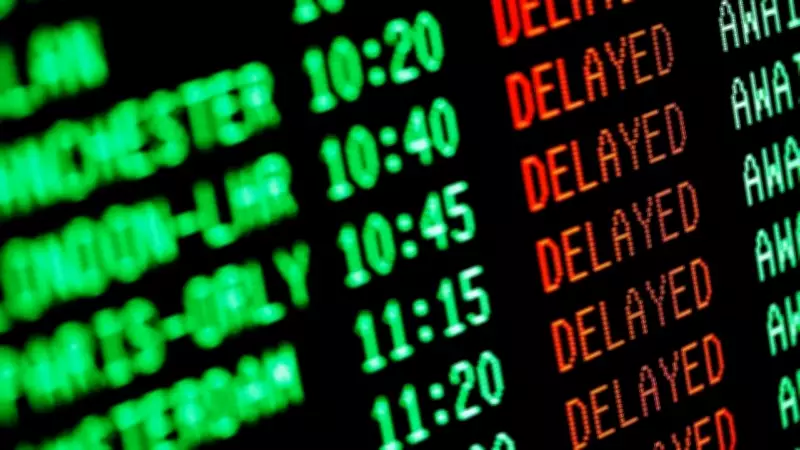
US Aviation Disruption Spreads Globally
The current aviation disruption in the United States is no longer confined to American travelers. What began as a problem stemming from thunderstorm weather conditions during the Memorial Day season has evolved into a crisis affecting flights on both national and international levels, covering North America, Europe, Asia, and the Caribbean.
FAA advisories issued today still report thunderstorms, winds, low visibilities, and traffic management constraints over major US airports such as Atlanta, Dallas-Fort Worth, Newark, Denver, San Francisco, Houston, Charlotte, Orlando, Miami, Boston, and New York airports.
The problem is not just poor weather. The US aviation system is facing a series of challenges simultaneously, including violent storms, air traffic congestion, FAA flow control, staff shortages, limited runway capacity, and an unprecedented spike in early summer air passenger numbers.

Unlike in earlier times, today's aviation industry is highly interconnected. When a disruption occurs somewhere, it has international impacts within hours as aircraft schedules, crews, luggage, and connections become misaligned.
Below is the list of countries currently most affected by the problems in the US aviation system.
Canada
Canada may well be the most affected country outside the US in terms of aviation disruptions. This is due to the close relationship between the two countries in international travel, making them one of the busiest air travel connections globally, between cities like Toronto, Vancouver, Montreal, Calgary, Ottawa, Chicago, Atlanta, New York, Dallas, Denver, Seattle, and San Francisco.
After a delay due to storms in the US, effects quickly show up on Canadian routes. Planes arrive late from America, schedules are missed, and passengers miss connecting flights to international destinations. For Canadians using US airports as transit hubs for international trips, the effects are worse, as problems in US cities like Dallas or Newark spread into Canada. Air Canada, United Airlines, Delta Air Lines, and American Airlines all suffer from this operational cascade effect.
United Kingdom
The close relationship between UK air services and those of the US is another factor leading to increasing disruption. Transatlantic flights between London Heathrow and cities such as New York, Atlanta, Chicago, Boston, Dallas, Washington, and Los Angeles are among the busiest and most commercially significant long-haul routes worldwide. The timing of flights on the transatlantic route is very tight. Flights arriving late at Heathrow due to delays at weather-beaten US airports can disrupt other flights to Europe, the Middle East, and Asia. Travelers flying between the two countries increasingly face problems with missing connecting flights, delayed flights, and delays from instability in the US aviation system.
Germany
The German aviation system is also highly susceptible to US operations disruptions, as Frankfurt and Munich serve as major European gateways for American flights. Flights from Germany to US cities such as Newark, Chicago, Dallas, Atlanta, Washington, and New York rely on proper scheduling and on-time arrival. When delays accumulate at US airports, flights end up delayed when leaving America for German destinations, leading to further disruptions across Europe due to Frankfurt's importance as a transfer point to Scandinavia, Eastern Europe, and Central Europe.
Japan
Japan is among the most affected Asian countries due to the current US flight instability. Aircraft flying from Tokyo to major US gateways including San Francisco, Los Angeles, Seattle, Chicago, Dallas, and New York fly for several hours and are not easy to recover in case of disruption. Any delay in California or New York can create scheduling problems for flights departing from Tokyo hours later. San Francisco International Airport is a critical point in this case. Strong winds recently forced the FAA to reduce arrival rates significantly due to safety spacing restrictions during poor weather, resulting in hundreds of delayed flights and cancellations. Passengers traveling with Japan Airlines and All Nippon Airways are more likely to miss their onward US flights.

South Korea
South Korea is also under this operational burden because Seoul's aviation system is extensively integrated with leading US gateways like Los Angeles, Seattle, San Francisco, Atlanta, and New York. When thunderstorms trigger FAA ground-delay procedures, US domestic schedules become extremely erratic. South Korean passengers arriving on long-haul transpacific flights often find themselves missing connecting flights within US airports. This issue becomes more complicated for airlines operating out of congested airports like Newark and San Francisco.
India
There have been no cases of huge cancellations on nonstop flights between India and the US, but Indians are experiencing indirect consequences in abundance. Travelers arriving in the US from Delhi, Mumbai, Bangalore, Hyderabad, or Chennai may need connecting flights from Newark, Chicago, Dallas, Atlanta, Washington, and San Francisco to reach secondary American destinations. If a storm develops in Atlanta or Dallas, or there is heavy traffic in Newark or San Francisco, Indians face missing domestic connecting flights, delayed baggage, overnight stays, and sudden rescheduling of flight times. This inconvenience primarily affects students attending university interviews, families on summer vacation, and business people visiting secondary US cities. The most frustrating aspect is that flights from India to the US themselves are operating without a hitch.
Mexico and Caribbean Tourism Destinations
Mexico and Caribbean tourism destinations have been hit hard by the consequences of ongoing US air travel disruptions. Destinations like Cancun, Mexico City, Punta Cana, Nassau, Montego Bay, and San Juan rely on aircraft arriving from southern US cities such as Miami, Orlando, Dallas, Houston, Charlotte, and Atlanta. Thunderstorms in Texas and Florida have constantly disrupted these tourist-oriented air corridors. For vacationers planning beach visits, disruption usually starts even before travelers leave their point of origin, in the form of delayed flights, gates being used up, FAA restrictions on air traffic, and thunderstorms causing delay cascades throughout the day. This has been especially apparent as the Caribbean and Mexico enter their peak international tourism period.
Why This Disruption Feels Unusually Widespread
While the problem could simply be due to storms, there is an underlying issue: the US aviation system lacks flexibility. The airspace is packed, airports operate near capacity limits, runways are undergoing construction, and staffing shortages plague air traffic control. Airlines face the challenge of coping with high summer demand and recovering from thunderstorms. San Francisco is constrained by reduced flexibility due to construction and new FAA safety spacing requirements. Newark continues to have congestion and telecommunications problems. Atlanta and Dallas, due to their sheer size and continuous thunderstorm weather, are especially vulnerable, according to the FAA official site. This means any disruption in weather leads to cascading events throughout the international aviation industry within hours. For example, thunderstorms in Atlanta automatically impact travelers worldwide, including in Toronto, London, Frankfurt, Tokyo, Seoul, Delhi, and Cancun, in a single day.





