

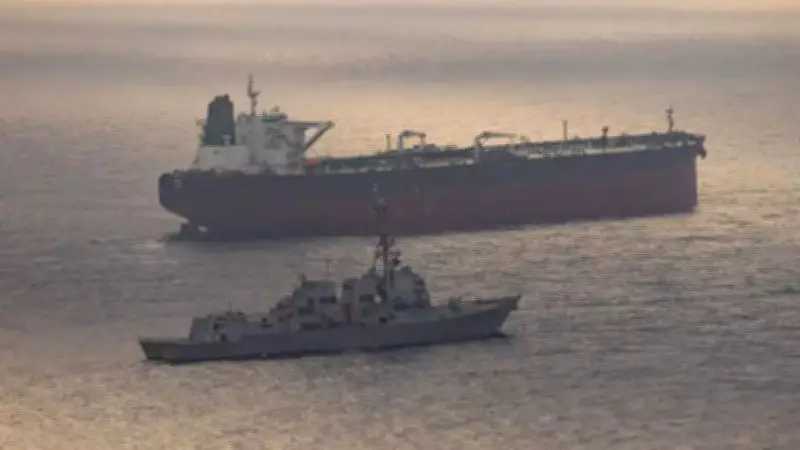
The United States has intensified naval pressure on Iran as diplomatic efforts in South Asia gain momentum, with a fresh interception at sea coinciding with planned indirect talks in Pakistan involving senior envoys from President Donald Trump's administration.
Naval Interception Details
US Central Command confirmed that the guided-missile destroyer USS Rafael Peralta intercepted an Iranian-flagged vessel on April 24 as it attempted to sail toward an Iranian port. The warship monitored the vessel before conducting a boarding operation for investigation, part of a widening maritime crackdown.
The Peralta is among the most advanced ships in the US Navy's fleet. An Arleigh Burke-class destroyer equipped with the Aegis Baseline 9 combat system, it can track and intercept complex air and missile threats while integrating data from other ships and aircraft. The vessel is named after Sergeant Rafael Peralta, who died saving fellow Marines during the Battle of Fallujah in 2004.

Pentagon Briefing
Speaking at a Pentagon briefing, Joint Chiefs Chairman Dan Caine stated that the US would continue enforcing what he described as a "full maritime blockade" targeting vessels linked to Iran. Since the campaign began on April 8, dozens of ships have been intercepted or turned away. Caine detailed earlier operations, including the seizure of vessels carrying sanctioned Iranian oil in the Indian Ocean and Pacific waters. In one case, US Marines boarded a disabled tanker via helicopter and took control. All detained vessels and their crews remain in US custody.
Diplomatic Efforts in Pakistan
Simultaneously, diplomatic channels are being tested in Pakistan, where US envoys Steve Witkoff and Jared Kushner are set to engage in indirect talks with Iran's foreign minister, Abbas Araghchi. Araghchi arrived in Islamabad, describing his visit as focused on "bilateral matters and regional developments," but Tehran quickly clarified that no direct meeting with US officials was planned. Pakistani authorities will act as intermediaries, relaying messages between the two sides.
The White House had earlier expressed cautious optimism. Press secretary Karoline Leavitt said the administration hoped the engagement would "move the ball forward to a deal," adding that senior figures including Vice President JD Vance and Secretary of State Marco Rubio remain on standby to join if progress is made.
Regional Context
The talks come amid continued instability across the Middle East. Fighting and disruptions to shipping through the Strait of Hormuz have driven up global energy prices and strained supply routes. While a fragile ceasefire remains in place, both Washington and Tehran continue to signal readiness for further escalation.
USS Rafael Peralta: Overview
The USS Rafael Peralta (DDG-115) is one of the United States Navy's most advanced guided-missile destroyers and a frontline warship built for modern naval combat. It belongs to the Arleigh Burke-class fleet, considered the backbone of America's surface naval power. Fast, heavily armed, and equipped with sophisticated radar and missile defense systems, the ship is designed to operate in dangerous waters. Today, the vessel is homeported at Yokosuka Naval Base, providing rapid access to the Indo-Pacific, East Asia, and Middle Eastern regions.
Namesake
The destroyer is named after Rafael Peralta, a US Marine killed during the Second Battle of Fallujah in Iraq in 2004. According to military accounts, Peralta was badly wounded when a grenade was thrown into a room with fellow Marines. Despite his injuries, he reportedly pulled the grenade under his body, absorbing the blast and saving others. He was posthumously awarded the Navy Cross. Born in Mexico City, he immigrated to the United States and became a US citizen while serving in the Marine Corps.
Technical Specifications
USS Rafael Peralta is a large multi-role destroyer built for endurance and combat. It is approximately 513 feet long, has a beam of 66 feet, and displaces more than 9,200 tons when fully loaded. The ship carries a crew of around 380 officers and sailors. It is powered by four General Electric LM2500 gas turbines producing around 100,000 shaft horsepower, allowing speeds above 30 knots.

Combat Systems
The ship's most important feature is the Aegis Combat System, one of the world's most advanced naval battle management networks. It can detect, track, and engage multiple aircraft or missile threats simultaneously while coordinating with other ships and aircraft. The destroyer carries a 96-cell vertical launch system capable of firing Standard surface-to-air missiles, ballistic missile interceptors, Tomahawk cruise missiles, and anti-submarine rockets. This allows the ship to defend fleets, intercept enemy missiles, strike land targets, and attack submarines.
The vessel also carries a 5-inch Mk 45 naval gun for shore bombardment and naval combat. For close-range defense, it uses the Phalanx Close-In Weapon System, a rapid-fire automated gun. Additional 25 mm cannons and machine guns provide further defense against small boats or nearby threats. USS Rafael Peralta is highly capable in anti-submarine warfare, equipped with torpedo launchers and two MH-60R Seahawk helicopters for submarine hunting, surveillance, and rescue operations.





