The concept of the "best" country to reside in seldom hinges on a solitary factor. A nation with robust wages may grapple with exorbitant housing costs. A country renowned for safety might present fewer economic prospects compared to a larger neighbor. Climate, healthcare, education, public services, social trust, and everyday comfort all influence how individuals perceive their living environment.
This is partly why annual happiness rankings garner significant attention. They do not concentrate exclusively on wealth or economic output. Instead, they aim to capture a more comprehensive picture of life as it is genuinely experienced. The latest World Happiness rankings place a familiar cluster of countries near the summit, though the list is not confined to Europe's wealthiest states. The top-performing countries in 2025 offer diverse lifestyles and histories, yet they share common attributes that continue to foster a high quality of life.
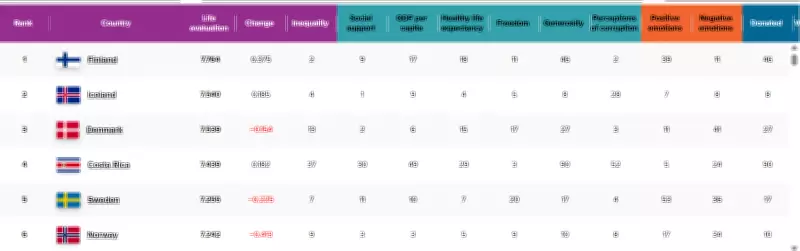
According to the World Happiness Report, here is the list of the happiest countries in the world.

World's 10 Happiest Countries to Live In
1. Finland
Finland retains its top position in the ranking, extending its streak over several years. The nation combines modern public services with a landscape deeply connected to nature. Forests blanket much of the land, while lakes shape both recreation and local identity. Even in Helsinki, access to green spaces is part of everyday life, not a luxury. Public institutions enjoy a high degree of trust. Education performs strongly by international standards, and healthcare is widely accessible. Daily life tends to be orderly without feeling overly rigid, which may explain Finland's repeated presence at the top of wellbeing surveys.
2. Iceland
Few countries blend dramatic geography with modern living quite like Iceland. Volcanoes, glaciers, and geothermal landscapes dominate the country's image, yet everyday life is shaped more by robust public institutions and a relatively close-knit society. The small population creates a social environment distinct from larger European nations. Renewable energy plays an unusually large role in national life. Combined with low crime rates and broad healthcare access, it contributes to living conditions that consistently place Iceland among the world's highest-ranked countries.
3. Denmark
Denmark follows closely, supported by a society where trust remains a defining feature. People often highlight the country's work-life balance. Long hours are not typically celebrated, and leisure time is considered vital for wellbeing rather than secondary to employment. Copenhagen garners much international attention, but the qualities associated with Danish life extend beyond the capital. Reliable public services, extensive cycling infrastructure, and strong local communities are found across the country.
4. Costa Rica
Costa Rica's presence in the top ten stands out because it achieves this without matching the wealth levels of many other countries on the list. Its reputation has grown from different strengths. Environmental protection forms a significant part of national policy, with large areas of forest and coastline preserved. Access to nature is not limited to remote regions but influences everyday life. Community ties also remain important. Many wellbeing assessments suggest that social relationships play a major role in how residents view their quality of life.
5. Sweden
Sweden's position near the top reflects strengths developed over decades. Public services are deeply established, and social policies emphasize family life, healthcare, and education. Workers benefit from protections that many countries still debate. The country has also built a reputation for blending innovation with social stability. Large global companies coexist with extensive welfare programs, creating a model distinctive within Europe.

6. Norway
Norway's economic success is often linked to its natural resources, but that tells only part of the story. Revenue generated over decades has supported extensive public services and a strong social safety net. Healthcare, education, and infrastructure consistently perform well by international standards. Life in Norway is also shaped by geography. Mountains, fjords, and long coastlines remain central to national identity. Outdoor recreation occupies a larger place in daily culture than in many comparable countries.
7. Netherlands
The Netherlands occupies a relatively small area yet consistently ranks among the most desirable places to live. Its cities are known for practicality. Public transport is extensive, cycling is woven into daily routines, and urban spaces are designed to remain accessible despite high population density. There is also a strong international dimension to Dutch society. Trade, education, and business have long connected the country to the wider world, fostering communities that feel outward-looking and adaptable.
8. Israel
Israel ranks eighth in the latest standings, reflecting a combination of economic development and strong social networks. The country has become a major center for technology and innovation, particularly in research, engineering, and digital services. This has contributed to a dynamic economy despite regional challenges. At the same time, family and community relationships remain highly significant in everyday life, often appearing as important factors in measures of wellbeing and life satisfaction.
9. Luxembourg
Luxembourg is among Europe's smallest countries yet continues to achieve some of the highest living standards on the continent. Its economy is highly developed and internationally connected. Cross-border movement is a normal part of daily life, with many people commuting from neighboring countries. The country also benefits from efficient public services and relatively high incomes. Despite its financial importance, Luxembourg often feels more relaxed than larger urban centers elsewhere in Europe.
10. Switzerland
Switzerland rounds out the top ten, reflecting its long-standing reputation for stability, prosperity, and high living standards. It performs particularly well in economic measures, ranking fourth for GDP per capita and sixth for healthy life expectancy, indicating strong financial security and favorable health outcomes. The country is also viewed positively for low levels of perceived corruption, ranking fifth in that category. Efficient public services, political stability, and a highly developed economy have helped build trust in institutions and support a strong quality of life.