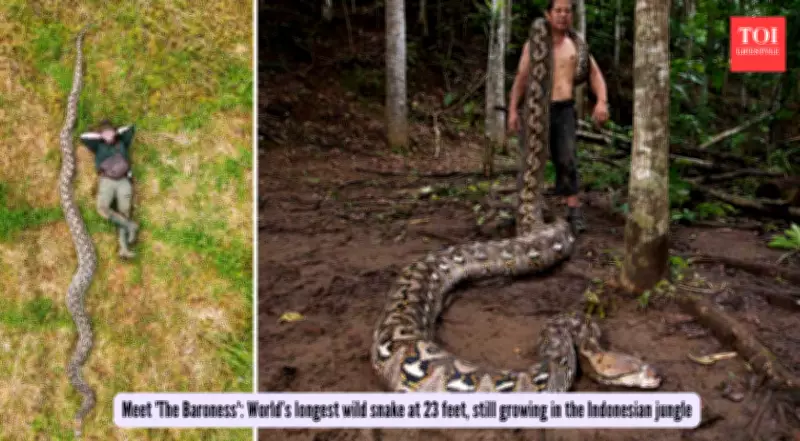
The Discovery of a Living Legend: 'The Baroness' Python
Deep within the lush, tropical forests of Indonesia, snakes have long captured human imagination, appearing in ancient legends, mythological pantheons, and local folklore as both revered deities and feared predators. These magnificent reptiles are not merely impressive in size; they serve as living connections to prehistoric eras, embodying nature's raw power and mystery.
Record-Breaking Dimensions Verified by Guinness
In a groundbreaking wildlife discovery, a female reticulated python has been officially recognized as the world's longest wild snake ever documented. Named Ibu Baron, or "The Baroness," this colossal serpent was measured at 7.22 meters (23 feet 8 inches) from head to tail on January 18, 2026, in South Sulawesi, Indonesia. Weighing 96.5 kilograms on rice scales, with estimates suggesting it may exceed 100 kilograms, the python's dimensions have been meticulously confirmed by Guinness World Records.
Wildlife guide Diaz Nugraha and photographer Radu Frentiu provided comprehensive photographic and video evidence to substantiate this extraordinary find. This verification is particularly significant, as historical claims—such as a purported 10-meter snake from Sulawesi killed in 1912—have often lacked credible documentation.

Surpassing Previous Records and Natural Averages
The Baroness shatters the previous record for the longest measured wild snake, which stood at 6.95 meters from Borneo in 1999, as reported in the Raffles Bulletin of Zoology in 2005. Reticulated pythons typically range from 3 to 6 meters in length, with females generally larger than males, making this discovery a remarkable outlier in the species' natural history.
Conservation Efforts and Survival Against the Odds
The survival of Ibu Baron is a testament to timely intervention, as giant pythons near human settlements frequently face lethal threats. These snakes are often killed for their meat, skins, or due to fears of livestock predation. Conservationist Budi Purwanto purchased The Baroness in December 2025 from finders in Maros, ensuring her safety alongside other rescued animals.
Radu Frentiu emphasized the peril faced by such large pythons, stating to National Geographic, "A python this large would likely be attracted to a village... And if it goes there, it will almost certainly be killed."
Habitat Loss and Increasing Human-Snake Encounters
Diaz Nugraha highlighted a growing trend of encounters between giant snakes and local communities, attributing it to environmental degradation. He told Guinness World Records, "Appearances of giant snakes are increasing because their habitats are reducing and availability of the snake’s natural food is decreasing, likely as the result of poaching."
This habitat loss not only endangers the snakes but also escalates conflicts with humans, underscoring the urgent need for protective measures.
Advocating for Stricter Legal Protections
Nugraha has called for enhanced conservation strategies, advocating for stricter safeguarding measures and robust laws to preserve forest ecosystems. He proposed implementing bans on killing snakes in protected areas to mitigate further threats to these majestic creatures.
The Potential for Even Larger Specimens
When questioned about the existence of even bigger snakes, Nugraha expressed confidence, suggesting that specimens reaching 9 meters or more could realistically exist, potentially within Indonesia's vast and unexplored jungles. This possibility fuels ongoing scientific curiosity and underscores the importance of continued wildlife exploration and preservation efforts.