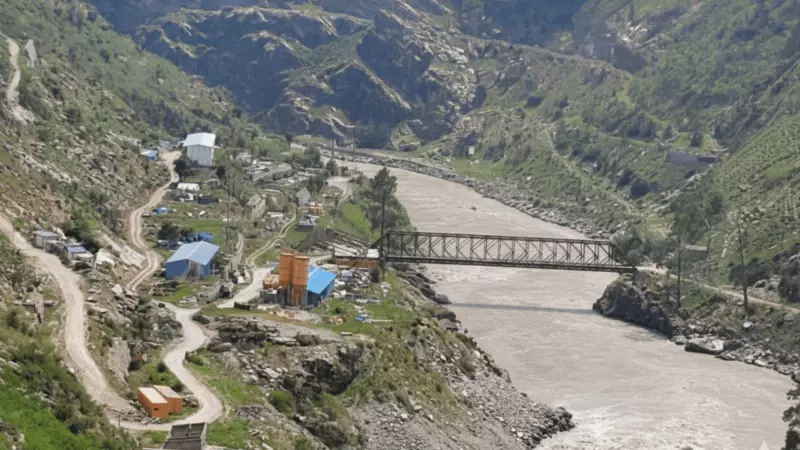
The Ratle Hydroelectric Power Corporation Limited (RHPCL) has formally requested an extension of the validity period for the environmental clearance (EC) granted to its 850 MW hydroelectric project on the Chenab River. The company has cited significant delays caused by prolonged litigation and the Covid-19 pandemic as the primary reasons for this appeal.
EAC to Review Extension Request This Week
The crucial decision now rests with the Expert Appraisal Committee (EAC) on river valley and hydroelectric projects under the Union Environment Ministry. The committee is scheduled to appraise RHPCL's extension request during its meeting on January 9, 2026. This development follows a recent visit by Union Power Minister Manohar Lal to the project site in Kishtwar, Jammu and Kashmir, where he laid the foundation stone for dam concreting works.
RHPCL, a joint venture between the National Hydroelectric Power Corporation (NHPC) and the Jammu and Kashmir State Power Development Corporation Ltd (JKSPDCL), is developing the project. The construction, awarded to Megha Engineering and Infrastructure Limited (MEIL) in January 2022, involves building a 133-meter tall concrete gravity dam on the Chenab in Kishtwar district.

The "Zero Period" Argument and Past Delays
In its submissions to the ministry, RHPCL argued that a substantial portion of the original clearance's validity was lost due to factors beyond its control. The project first received its environmental clearance in December 2012, valid until 2022, with extensions allowing it to remain effective until December 11, 2025.
The company is invoking recent office memorandums from the environment ministry to seek an extension. It points to an October 2025 order that allows project developers to rationalize time lost during court proceedings as a "zero period," meaning it shouldn't count against the clearance validity. Additionally, a 2021 notification granted a relaxation for the period from April 2020 to March 2021 due to the Covid-19 pandemic. RHPCL contends that combining these provisions justifies an extension for the Ratle project.
A History of Litigation and Ongoing Controversies
The project's journey has been marred by legal battles since its inception. Initially awarded to the GVK Group, which withdrew in 2014, the project became entangled in litigation starting April 2016. Cases were fought across multiple judicial forums, including the Arbitral Tribunal, Kishtwar District Court, Jammu and Kashmir High Court, and the Supreme Court. A district court injunction in April 2016 ordered a status quo, halting construction.
The legal landscape shifted when the Supreme Court dismissed GVK's appeal in 2017, and an Arbitral Tribunal in 2018 directed that the project be awarded to a new entity. RHPCL was subsequently formed in 2019.
However, challenges persist. The project is currently under scrutiny by the National Green Tribunal (NGT), which has heard allegations of illegal muck dumping into the Chenab by the contractor, causing flood-related losses to Thathri village. The NGT reserved its judgment on this matter on December 9, 2025.
Further controversy emerged with allegations from Megha Engineering officials about interference in recruitment by a BJP legislator. A police report also flagged the alleged engagement of individuals with militant links in the construction work.
Geopolitically, the Ratle project has been a point of contention with Pakistan, which had challenged its design under the now-suspended Indus Water Treaty (IWT). With the IWT in abeyance, India has accelerated work on Chenab basin projects like Ratle and Sawalkote, recently granting clearance for Dulhasti Stage-II as well.