

African Tectonic Rift Could Create Mountains Taller Than Himalayas
Deep beneath our feet, the planet engages in a continuous geological dance of push and pull, with tectonic plates shaping everything from continental coastlines to global climate patterns. These monumental processes unfold over timescales that make human civilization appear as a mere fleeting moment in Earth's history. Now, researchers are focusing their attention on a dramatic geological event unfolding in Africa, where the continent is slowly tearing itself apart along a massive rift system.
The Great Rift Valley: A Continent in Motion
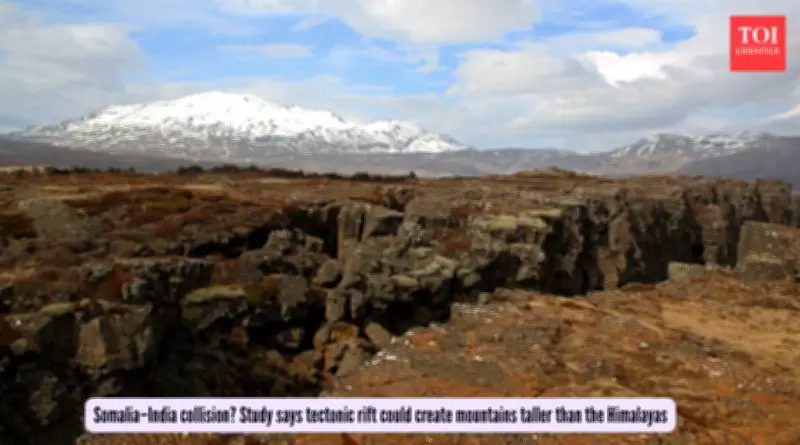
The East African Great Rift Valley represents a visible manifestation of this continental separation, driven by powerful heat rising from deep within Earth's mantle. This thermal energy pushes tectonic plates in opposite directions, creating a growing fracture in Africa's outer crust that has been developing for approximately 25 million years. According to geological research, this rift marks the initial stage of a process that will eventually transform into a true ocean basin.
"The spreading zone marks the first irreversible step in a sequence that shifts ocean basins and steers drifting landmasses toward impact," explains Douwe J. J. van Hinsbergen from Utrecht University, whose team has been tracking this geological evolution. As the continental crust continues to thin and sink, seawater will eventually rush into the expanding rift, forming new seafloor from cooling magma and triggering underwater seismic activity.

From Ocean Formation to Mountain Creation
This geological process aligns with Earth's supercontinent cycle, where continents periodically merge into massive landmasses before breaking apart again over hundreds of millions of years. As the East African rift develops, Somalia and Madagascar are predicted to drift away from mainland Africa while trenches in the Indian Ocean gradually close the distance to the Indian subcontinent.
The most dramatic consequence of this tectonic movement could be a future collision between Somalia and India, similar to the ancient impact between India and Eurasia that created the Himalayan mountain range 40-50 million years ago. When these landmasses eventually converge, the thick continental crust would buckle skyward, thrusting rocks over each other and folding them into massive mountain belts that could potentially surpass the height of today's Himalayas.
Global Impacts of Geological Transformation
The creation of such monumental mountain ranges would have profound effects on global geography and climate patterns. New peaks could reroute atmospheric wind patterns, trap moisture to create different rainfall distributions, and slice existing habitats into isolated pockets, fundamentally altering monsoon systems and biodiversity patterns across affected regions.
These geological changes would also reshape coastlines, potentially creating new ocean basins while closing existing ones. The movement of Somalia away from Africa could eventually give it its own ocean coastline, shifting maritime trade routes and fisheries in the region. Subduction zones—where tectonic plates dive beneath one another—would pull seafloor downward, compressing islands and folding coastlines into emerging mountain ranges.
Scientific Modeling and Limitations
Predicting tectonic shifts over such vast geological timescales presents significant challenges for researchers. Van Hinsbergen and his colleagues describe their work as a structured thought experiment based on current geographical understanding and reliable physical principles. Their models require specific initial conditions and assumptions about how geological processes will unfold.
"Even with reliable physics, models cannot precisely forecast peak heights, as factors like rainfall and rock durability influence erosion rates," the researchers note. The East African rift currently represents only the initial stage of this multi-million-year process, with future developments depending on the precise locations where new subduction trenches emerge.

Despite these limitations, the research provides valuable insights into Earth's dynamic geological future, reminding us that our planet's surface remains in constant, albeit slow, transformation. The mountains that dominate our landscapes today are temporary features in geological time, destined to be replaced by new ranges as tectonic forces continue their relentless work beneath our feet.





