Andhra Pradesh Forest Department Sets Ambitious Goal for Olive Ridley Turtle Conservation
The Forest department in Andhra Pradesh is embarking on a significant conservation effort, planning to collect over seven lakh Olive Ridley turtle eggs this year. Officials have confirmed that arrangements are in place to support this initiative, noting a steady increase in hatchling numbers in recent years.
Extensive Infrastructure and Protection Measures Deployed
Across the districts of Visakhapatnam, Anakapalli, Vizianagaram, and Srikakulam, a total of 31 hatcheries have been established. Srikakulam leads with 16 hatcheries, followed by Vizianagaram with 10. The North Andhra circle has deployed 98 protection watchers to oversee these operations, ensuring the safety of the eggs and hatchlings.
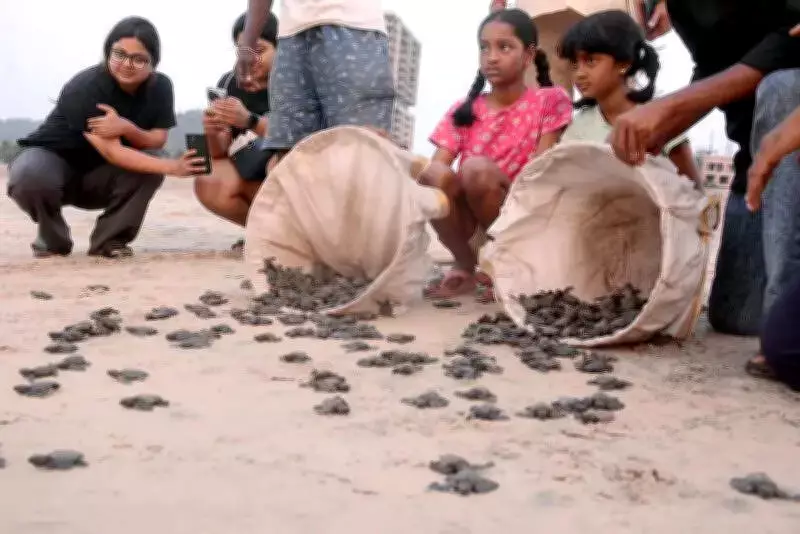
The egg collection season commenced the day after Pongal. To date, 3.98 lakh eggs have been collected and placed in 3,460 nests. The distribution includes 2,423 nests in Srikakulam, 521 in Visakhapatnam, and 436 in Vizianagaram. By March 15, 2,313 hatchlings had been successfully released into the sea, with 1,269 from Visakhapatnam and 1,051 from Srikakulam.

Migration Patterns and Nesting Habits
Olive Ridley turtles migrate from foraging grounds such as Sri Lanka to nest along the Andhra Pradesh coastline between November and May, with peak nesting occurring from December to April. The state lies along the migratory route connected to Odisha's major rookeries at Gahirmatha and Rushikulya.
Visakhapatnam CCF Dr. Mydeen explained that nesting typically occurs near river mouths and estuaries, with historical densities ranging from 15 to 100 nests per kilometer. Unlike the mass arribadas seen in Odisha, Andhra Pradesh's 1,000-kilometer coastline along the Bay of Bengal serves as an important sporadic nesting site.
Conservation Efforts and Threats
Olive Ridleys (Lepidochelys olivacea) are listed as Vulnerable by the IUCN and protected under Schedule I of the Wildlife Protection Act, 1972. In addition to the Forest department's efforts, the Wildlife Management Authority and Coringa Wildlife Sanctuary have conserved nearly 20,000 eggs collected from 174 nests on Hope Island in Kakinada Bay, recognized as one of the safest nesting grounds in the state.
However, significant threats persist. CCF Mydeen highlighted dangers such as dog and bird predation, jackals, coastal development, artificial lighting, plastic pollution, and oil discharge, which pose major risks to eggs and hatchlings.
Collaborative Conservation and Past Successes
The Forest department collaborates with NGOs, the Coast Guard, Marine Police, fisheries department, fishermen, and corporate partners. Protection watchers play a crucial role in identifying nests, collecting eggs, and releasing hatchlings.
Last year's efforts yielded impressive results: 6,662 nestings were recorded in Andhra Pradesh, with the department collecting 6.89 lakh eggs. These were protected in 73 hatcheries with assistance from 247 watchers, leading to the release of 6,02,374 hatchlings. In the Visakhapatnam Circle alone, 3,933 nestings produced 4.37 lakh eggs, and 3,98,647 hatchlings were released.
This year, progress continues with 742 nestings identified so far and approximately 86,000 eggs collected, underscoring the ongoing commitment to preserving this vulnerable species.