Faridabad's Aravali Foothills Face Illegal Leveling and Ecological Damage in Kot Village
In a concerning development, parts of nearly 25 acres of sandy Aravali foothills in Faridabad's Kot village have been freshly leveled, with portions of a natural water channel buried under soil and numerous trees cut down. This activity is occurring on shamlat deh, or village common land, where any occupation, alteration, or change of land use is strictly prohibited by law. According to legal provisions, such land must remain with the gram panchayat for collective purposes and cannot be sold, transferred, or used for private activities.
Site Falls Under Protected Aravali Tract and PLPA Regulations
The site also falls within an Aravali tract notified under Section 4 of the Punjab Land Preservation Act (PLPA). This law is designed to prevent soil erosion and ecological degradation, explicitly barring tree-felling, land breaking, earthmoving, and any other non-forest activity without prior approval. In the area where work is ongoing, entities linked to an Indian conglomerate had previously purchased large tracts of land.
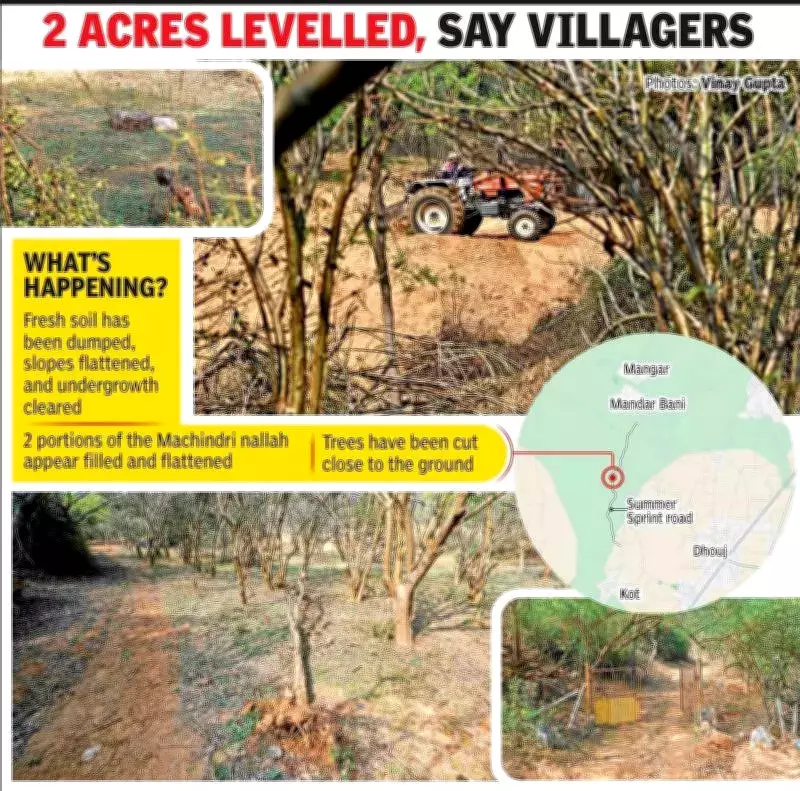
During a recent visit, soil was observed spread across slopes, and portions of the Machindri nallah, a seasonal natural water channel, were filled with soil. A tractor was actively moving across the incline, pouring sand to level more of the terrain. Locals estimate that approximately two acres of land have been flattened so far, while the larger tract remains untouched for now.

Ecological Risks and Legal Violations Highlighted by Experts
Foothills characterized by sandy soil are highly erosion-prone, and flattening them can destabilize the slope, leading to severe environmental consequences. Kot sarpanch Kesar Singh stated, "This is village common land. No permission has been given for any such activity." Conservationist Sunil Harsana warned that burying natural water channels and leveling foothills will choke groundwater recharge, worsen flood vulnerability, and fragment wildlife corridors.
He emphasized, "Flattening terrain and cutting trees destroys the natural functions of foothill systems." Lt Col SS Oberoi (retd), a legal activist, added, "Sandy Aravali foothills in Kot have forest cover and would meet any reasonable criteria for forests according to the dictionary meaning. The current activity is a violation of the Forest Conservation Act, as it is a non-forest activity in a deemed forest."
Ongoing Legal Battles and Government Response
In December 2025, the Punjab and Haryana High Court issued a notice to the Haryana government after residents challenged a land consolidation notification. Petitioners argued that this could break up village common land and leave plots without access roads, forcing distress sales. They contended that consolidation cannot proceed until shamlat land is identified and restored to the panchayat, as required by law. Additionally, they highlighted that large stretches of Kot's land lie within Aravalli terrain and gair mumkin pahar, where consolidation or alteration risks significant ecological damage. The next hearing at the high court is scheduled for April 20.
Forest officials have acknowledged the issue and pledged to investigate. Surender Dangi, divisional forest officer of Faridabad, said, "We will get it checked and initiate action accordingly." This incident underscores the ongoing tensions between development activities and environmental conservation in ecologically sensitive regions like the Aravalis.