

Chandigarh Administration Submits Comprehensive Environmental Compliance Report to NGT
In a significant development, the Chandigarh Union Territory administration has filed a detailed compliance report with the National Green Tribunal (NGT), outlining substantial progress in addressing environmental concerns related to wastewater and solid waste management. The report, submitted by UT Chief Secretary H Rajesh Prasad, focuses on adherence to the Municipal Solid Waste Management Rules of 2016 and other critical ecological issues.
Wastewater Discharge Points Successfully Intercepted
The administration has confirmed that all identified wastewater discharge points into local choes (seasonal streams) have been effectively intercepted. According to the report, routine inspections and repairs are being conducted to ensure ongoing compliance. Specifically, 17 discharge points into Sukhna Choe, 19 into N-Choe, and six into Patiala Ki Rao have been identified and tapped. This action comes in response to several recent incidents where sewage was found discharging into these water bodies, highlighting the urgency of the measures.
Expansion of Tertiary Treated Water Network Underway
A major initiative is the city-wide distribution network for tertiary treated (TT) water, aimed at maximizing the reuse of treated wastewater. The administration is laying 165 kilometers of distribution pipelines, including extensions to industrial areas. The network will be expanded to cover:

- Additional parks, gardens, and green belts
- Schools, colleges, and community centers
- Government offices
- Residential properties of one kanal (4,500 square feet) or larger
- Roundabouts and road berms
New user connections are being provided concurrently with pipeline installation. The project is scheduled for completion by June 30, 2026. Upon completion, the utilization of tertiary treated water is expected to reach nearly 90 million liters per day (MLD), significantly reducing freshwater dependency.
Wastewater Treatment Achievements and Future Plans
Almost all wastewater generated in Chandigarh is currently being treated in Sewage Treatment Plants (STPs), with the exception of 1-2 MLD from Faidan village on the Chandigarh-Punjab boundary. To address this gap, two modular STPs with a capacity of 750 kiloliters per day (KLD) each have been proposed. One is already operational, and the second is expected to be commissioned by May 30, 2026.
Solid Waste Management: Segregation and Legacy Waste Clearance
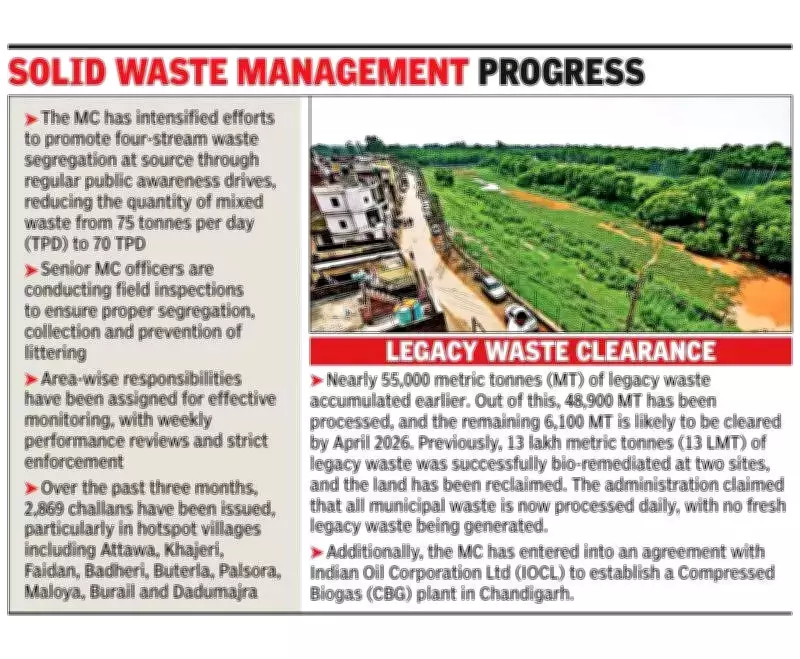
The Municipal Corporation (MC) has intensified efforts to promote four-stream waste segregation at source through regular public awareness campaigns. This initiative has reduced the quantity of mixed waste from 75 tonnes per day (TPD) to 70 TPD. Senior MC officers are conducting field inspections to ensure proper segregation, collection, and prevention of littering. Area-wise responsibilities have been assigned for effective monitoring, with weekly performance reviews and strict enforcement measures. Over the past three months, 2,869 challans have been issued, particularly in hotspot villages such as Attawa, Khajeri, Faidan, Badheri, Buterla, Palsora, Maloya, Burail, and Dadumajra.
Regarding legacy waste, nearly 55,000 metric tonnes (MT) had accumulated earlier. Out of this, 48,900 MT has been processed, and the remaining 6,100 MT is likely to be cleared by April 2026. Previously, 13 lakh metric tonnes (13 LMT) of legacy waste was successfully bio-remediated at two sites, and the land has been reclaimed. The administration claims that all municipal waste is now processed daily, with no fresh legacy waste being generated.
Innovative Partnership for Compressed Biogas Plant
In a forward-looking move, the MC has entered into an agreement with Indian Oil Corporation Ltd (IOCL) to establish a Compressed Biogas (CBG) plant in Chandigarh. This partnership aims to enhance sustainable waste management practices and contribute to renewable energy production.

The compliance report underscores Chandigarh's commitment to environmental sustainability, with targeted deadlines set for 2026 to complete key infrastructure projects and waste management initiatives.





