

Climate Change Triggers Increased Underwater Volcanic Activity, CSIR-NIO Study Finds
Scientists from the National Institute of Oceanography (CSIR-NIO) in Goa have conducted groundbreaking research revealing how climate change influences polar ice volume and sea levels, which in turn activates underwater volcanoes along mid-ocean ridges. Their study provides crucial insights into the long-term dynamics of these geological systems.
Understanding Mid-Ocean Ridge Hydrothermal Systems
Mid-ocean ridges (MORs) are massive underwater mountain ranges where tectonic plates diverge, allowing magma from Earth's interior to rise and create volcanic activity. This magma heats surrounding rocks and seawater that infiltrates through cracks, producing hydrothermal vents that eject metal-rich hot water. These systems function as natural pipelines, transferring heat and essential metals from the planet's interior into the ocean.
The study notes: "While short-term hydrothermal dynamics are well studied, the long-term response of these systems at slow spreading ridges to glacial interglacial sea-level change remains poorly constrained."

Focus on the Carlsberg Ridge in the Indian Ocean
Researchers concentrated on the Carlsberg Ridge, a slow-spreading ridge in the Indian Ocean where seafloor formation occurs gradually, leading to intermittent volcanic activity. To reconstruct past volcanic behavior, they extracted sediment cores containing iron-manganese oxyhydroxide coatings—rust-like deposits that absorb chemicals from seawater and hydrothermal vents.
By analyzing lead isotopes in these coatings, scientists distinguished between signatures from magma and terrestrial dust. During periods of intense volcanic activity, the coatings exhibited magma-derived isotopic patterns.
Sea Level Changes Drive Volcanic Activity
Comparing chemical data with historical ice age timelines over the last 49,000 years, researchers identified a strong correlation. Lower sea levels during glacial periods, such as 60,000 years ago, reduced hydrostatic pressure, enhancing underwater volcanism along the Carlsberg Ridge. This increased activity released more heat and carbon dioxide into the ocean.
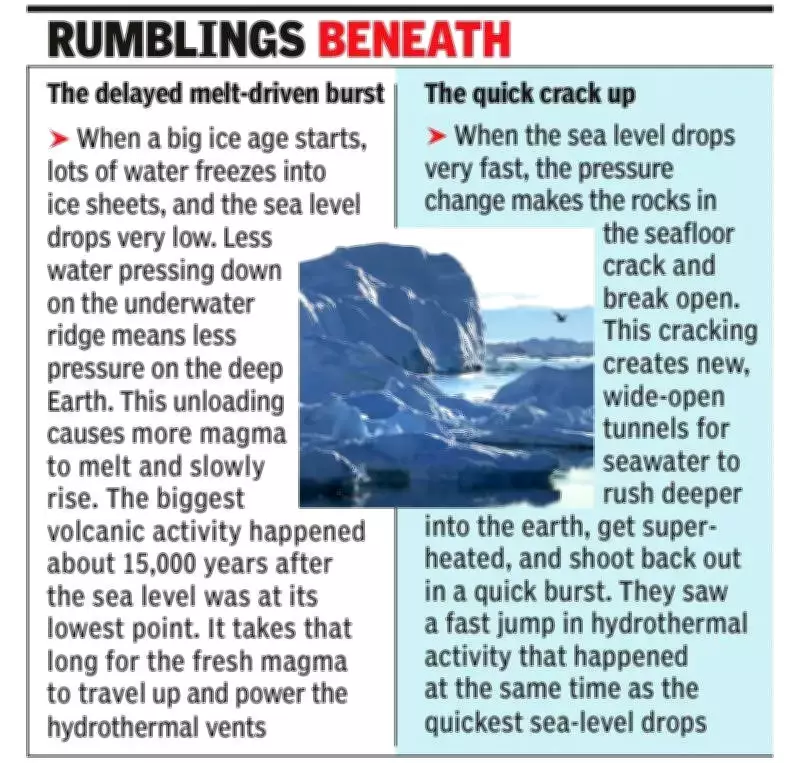
The study outlines two primary mechanisms through which sea level fluctuations stimulate underwater volcanoes:
- Delayed melt-driven burst: Gradual responses to pressure changes.
- Quick crack-up: Immediate tectonic adjustments.
Broader Implications for Ocean Chemistry and Climate
This research demonstrates that hydrothermal systems at slow-spreading ridges like the Carlsberg Ridge are highly sensitive to global climate shifts, including ice age cycles. These underwater vents disperse critical trace metals—such as cobalt, nickel, and chromium—into the deep ocean, potentially nourishing marine microorganisms and altering ocean chemistry.
The study concludes: "Hydrothermal systems at slow‐spreading ridges functioned as sensitive archives of past climatic forcing and played an active role in modulating deep ocean trace metal flux across glacial‐interglacial cycles."
These findings underscore the intricate connections between climate change, sea level variations, and geological processes, highlighting the need for continued monitoring of underwater volcanic systems to better understand their role in Earth's climate system.






