

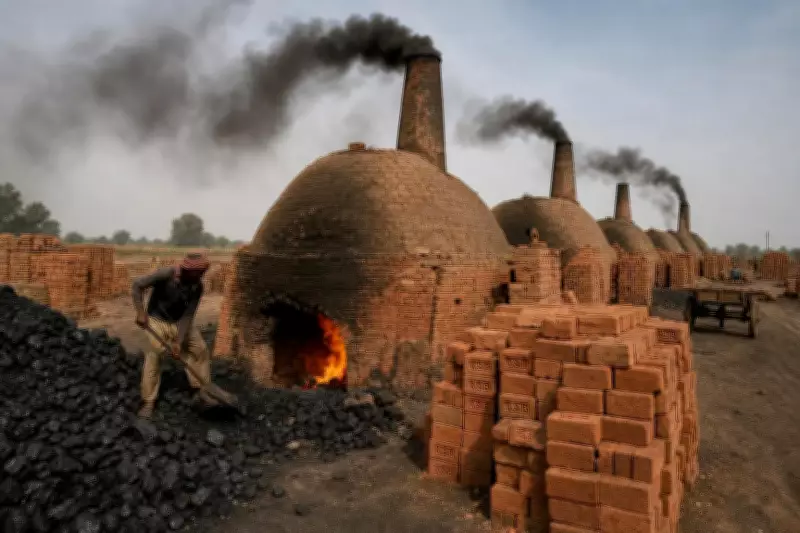
New Delhi: Despite a ban, coal continues to be widely used in brick kilns across Delhi-NCR, according to a survey by the Centre for Science and Environment (CSE). The report, titled 'Rules Without Reach: How the brick-making industry has fared on CAQM compliances in Delhi-NCR', highlights widespread non-compliance, weak enforcement, poor transition support, and limited adoption of cleaner fuels in the brick-making sector, which is a significant contributor to Delhi's air pollution.
Survey Findings
The survey was conducted in two rounds across brick kiln clusters in Delhi-NCR. The first round in 2025 covered 128 brick kilns, while the second round in 2026 surveyed 152 kilns in Baghpat, Ghaziabad, Bulandshahr, Shamli, Jhajjar, Panipat, and Sonipat, along with virtual communications with 60 kiln owners. The report noted the use of carbon black as fuel at several kilns, with stocks typically stored discreetly and supplied mainly at night.
Coal Usage Trends
In 2025, about 77% of the surveyed kilns were found using coal, while in 2026, coal use was observed in about 72% of the surveyed units. Most kilns used coal in combination with biomass rather than as a standalone fuel. Coal deliveries were often arranged on a daily basis and frequently took place during evening or night hours.

Reasons for Non-Compliance
The report explains that kiln owners consistently maintained that coal was essential for producing good quality bricks, as biomass lacks the same calorific value. Coal offers 4,000 to 6,000 kcal/kg, while most crop residues provide only 3,000-4,000 kcal/kg. 'Most owners said a blend of at least 20-30% coal with 70-80% biomass is the minimum needed to maintain product quality. Going to zero coal, as the mandate requires, is something the sector is not technically ready for, and the research needed to get it there has not been done at the scale required,' said CSE.
Structural Issues
All 128 kilns surveyed in 2025 and the 152 kilns surveyed in 2026 had formally converted from the conventional fixed chimney bull's trench kiln to zig-zag technology as mandated. However, the conversion on paper has not meant conversion in practice. Around 70% of the evaluated kilns had cracks, broken walls, or poor-quality plastering. In a zig-zag kiln, structural integrity is essential; cold air leaks through any opening, heat escapes, and fuel consumption rises.
Lack of Green Cover
In 2025, no green cover was observed in about 82% of the surveyed kilns, while 78% had no green cover in 2026. Only two surveyed kilns in 2026 had sufficient plantation on their premises. The report also noted that brick kilns were found operating in close proximity to schools in Bulandshahr and Panipat.
Expert Commentary
'The brick industry is among the most polluting and least regulated sectors in the country. Commission for Air Quality (CAQM)'s coal ban was a necessary step, but a direction without a transition strategy is unlikely to change behaviour on the ground,' said CSE programme officer Subhrajit Goswami. He added that the sector needs technical guidance, financial support, and institutional hand-holding. 'None of that was provided, and the survey results reflect exactly that gap,' he pointed out.
Recommendations
The report recommended technical assistance to support fuel transition, development of monitoring mechanisms to prevent coal supply to NCR kilns, standardisation of biomass fuel quality, and better collaboration between regulators and technical institutions to facilitate compliance.






