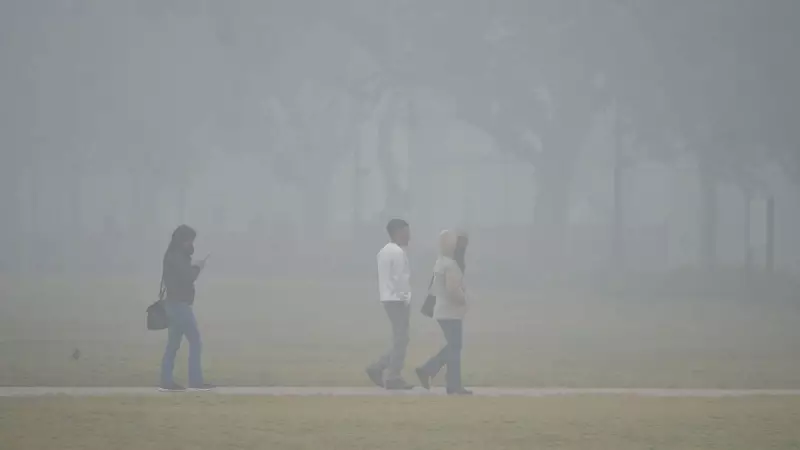
A severe cold grip tightened over the national capital on Wednesday, December 31, 2025, with weather officials predicting that the frigid conditions will extend into New Year's Day. Adding to the chill, the first winter rain of the season is a distinct possibility for the region.
Temperature Dips and Persistent Cold Day Conditions
The India Meteorological Department (IMD) recorded the minimum temperature in Delhi at 6.4 degrees Celsius, which is approximately 0.4 degrees below the seasonal average. The city experienced foggy and cold conditions in the morning, which transitioned into a 'cold day' scenario that lasted throughout Wednesday.
An IMD official explained that a 'cold day' is officially declared when the minimum temperature falls below 10 degrees Celsius and the maximum temperature remains about 4.5 degrees below normal. These conditions are expected to persist through the night and into Thursday.

Rain Prospects and Dense Fog Disrupt Visibility
The forecast for January 1 indicates a generally cloudy sky with a chance of very light to light rain at isolated places. Mahesh Palawat, a meteorologist from Skymet Weather, attributed this to an induced cyclonic circulation over Punjab and Haryana. "There is a slight chance of very light and isolated rain over Delhi and the NCR between tonight and New Year’s Day," Palawat told PTI. He noted that if this occurs, it would mark the season's first spell of rain.
Meanwhile, dense fog severely hampered visibility across the city on Wednesday morning. Key observations from the weather department included:
- Safdarjung reported visibility as low as 50 metres between 6:30 AM and 7:30 AM, improving to 100 metres by 8 AM.
- Palam recorded visibility of 50 metres between 4 AM and 7:30 AM, which later improved to 150 metres by 8 AM.
IMD scientist Dr. Naresh Kumar stated that dense to very dense fog has been affecting north India for nearly two weeks and may recur at isolated places in Delhi on Thursday morning.
Weather Pattern and Upcoming Cold Wave Threat
Dr. Kumar explained the current meteorological setup, pointing to an active western disturbance positioned over north Pakistan. This system is causing light to moderate rainfall and snowfall in the western Himalayan region, with very light rainfall possible over the NCR.
He further clarified how fog contributes to the prolonged cold. "Fog forms when temperatures are low, winds are light and moisture levels are high. When these conditions persist, fog stays longer during the day, blocks sunlight and helps cold day conditions continue," he said.
Looking ahead, the IMD has forecast dense fog to likely persist in Delhi for the next five days. More concerning is the prediction from Skymet, which indicates that coldwave conditions may develop from January 3. The minimum temperature could plunge below 5 degrees Celsius as cold northerly winds from the Himalayan region sweep towards the capital.
For New Year's Day, the IMD predicts maximum temperatures to hover between 14 and 16 degrees Celsius, with minimums ranging from 9 to 11 degrees Celsius. Shallow to moderate fog is expected during the morning hours.