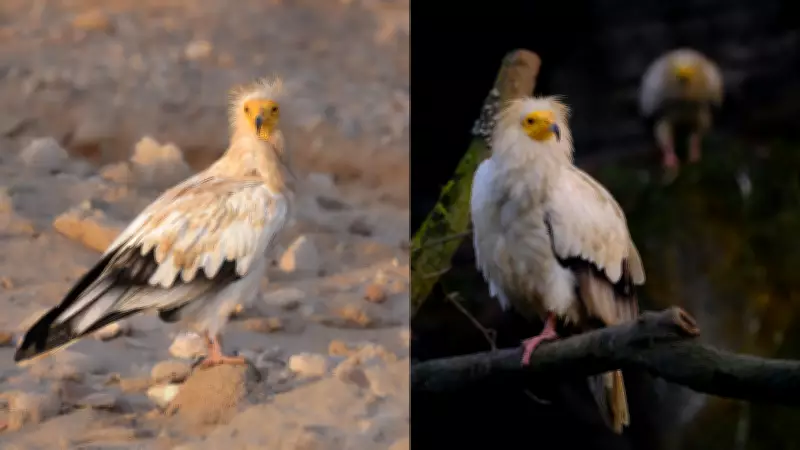
The endangered Egyptian Vulture, scientifically known as Neophron percnopterus, is facing the threat of local extinction in the Rayalaseema district of Andhra Pradesh, causing significant concern among conservationists, scientists, and wildlife experts. Once a common sight soaring over the rocky and dry terrain of the Sri Sathya Sai district, this bird has experienced a massive population decline in recent times. The primary causes include habitat loss, quarrying, electrocution by high-tension wires, and poisoning from livestock carcasses laced with toxins.
Scientific Recommendations for Conservation
Scientists at the Centre for Cellular and Molecular Biology, funded by the Department of Biotechnology under the Ministry of Science and Technology, Government of India, have recommended immediate conservation steps. These include creating safe feeding areas for the birds, conducting scientific counts of their populations, and protecting their habitats. The Egyptian vulture is listed as an 'endangered' species by the IUCN Red List and falls under Schedule I of the Indian Wildlife (Protection) Act of 1972, which provides the highest level of legal protection. Despite this, researchers have observed that the species is rapidly vanishing from parts of Rayalaseema.
Research Findings on Population Decline
Studies conducted by researchers on vulture habitats around Ratnagiri Fort in Sri Sathya Sai district have highlighted the extinction of this bird from its usual habitat. In a study titled 'Status and Distribution of Vultures in Andhra Pradesh, India,' conservationists emphasized the urgent need for measures to monitor population sizes and reproduction. An evaluation by the International Union for Conservation of Nature (IUCN) identified electrocution along overhead electric power lines and poisoning from livestock carcasses treated with veterinary medicines as two major threats to vultures in India.

Urgent Need for Habitat Protection
Researchers warned that nesting grounds of the Egyptian vulture must be protected immediately to prevent local extinction. The study, sponsored by the Ministry of Environment, Forest and Climate Change, noted that in parts of Andhra Pradesh, the Egyptian vulture is on the brink of becoming locally extinct. Vultures play a critical role as nature's scavengers, cleaning dead bodies rapidly and preventing disease outbreaks. The Animal Demography and Ecology Unit at the Institute for Mediterranean Studies (IMEDEA), Spain, emphasized that vultures contribute to ecosystem services such as waste recycling and disease control.
Ecosystem Importance of Vultures
Scientists from the Department of Paraclinical Sciences at the University of Pretoria reported that the decline in vulture populations is attributable to the veterinary use of diclofenac, a drug that causes death in various vulture species. A conservation article titled 'The global contribution of vultures towards ecosystem services and sustainability: An experts’ perspective' stated that vultures are essential to ecosystems as they consume carrion and prevent disease transmission. The disappearance of vultures increases the risk of diseases such as rabies and anthrax. Egyptian vultures hold both ecological and cultural significance, particularly in arid areas of south India like Rayalaseema.
Conservation Measures Urgently Needed
Conservation bodies and wildlife researchers are pressuring the Andhra Pradesh Forest Department and the Union Government to take urgent recovery actions. Suggested measures include:
- Setting up vulture-safe feeding areas
- Installing bird diverters at hazardous electric poles
- Scientific monitoring of vulture populations
- Protecting rocky hills against quarrying operations
- Creating awareness among livestock keepers about dangerous veterinary drugs
Vulture Safe Zones also deserve attention, as monitored landscapes ensure safe food and reduce the danger of drug and human interaction for these birds. Dr. Sujit Narwade highlighted the significance of scientific and inter-agency efforts for vulture recovery in India, stating that establishing Vulture Safe Zones and improving carcass management are vital for these birds to thrive and maintain their ecological roles.

Hope for Survival with Immediate Action
Vulture researchers believe that there is still hope for the survival of the Egyptian vulture in Rayalaseema if immediate action is taken. Delay could lead to the complete extinction of the species in the area. Environmentalists point out that the threat to Egyptian vultures is indicative of greater biodiversity issues plaguing the dryland ecosystem of Rayalaseema, including mining activities, destruction of natural habitats, and improper infrastructure development. Saving the Egyptian vulture is not just about conserving one species but ensuring ecological stability before more harm befalls the ecosystem.