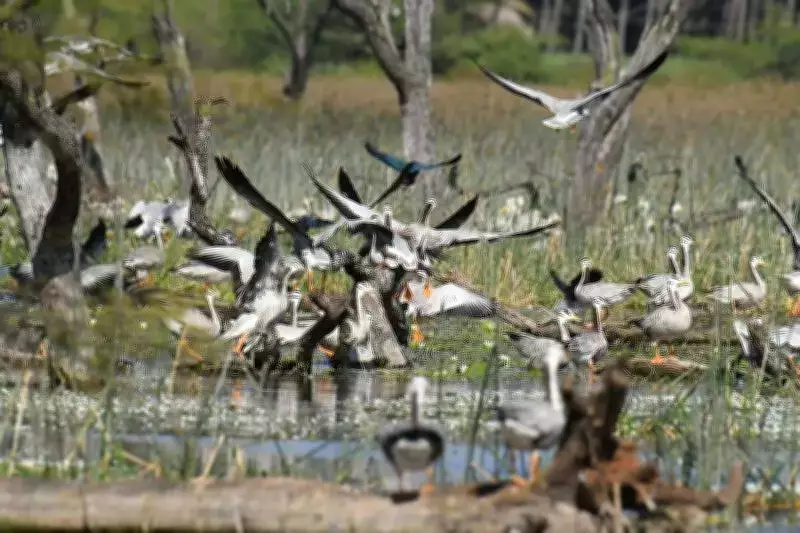
Fishing Moratorium Turns Hadinaru Lake into Bustling Bird Sanctuary
The implementation of a three-month fishing prohibition has spectacularly transformed Hadinaru Lake, located near Suttur, into a flourishing sanctuary for migratory avian species. This conservation measure has particularly benefited the remarkable Bar-Headed Goose, which undertakes an epic journey spanning thousands of kilometres from its breeding grounds in Mongolia to winter in this serene waterbody.
Winter Haven for High-Altitude Migrants
Hundreds of these distinctive geese, celebrated for their extraordinary high-altitude migrations across the formidable Himalayan mountain range, have descended upon the lake. Their arrival solidifies Hadinaru's reputation as a preferred winter roosting location. Situated approximately 25 kilometres from Mysuru city on the Mysuru-Nanjangud border, adjacent to the Kabini River in Chikkayyana Chatra Hobli of Nanjangud taluk, the expansive lake has once again become a focal point for birdwatchers and nature aficionados.
The geese are immediately identifiable by the prominent black bars adorning their heads and their resonant, characteristic honking calls that now reverberate across the tranquil waters. As paddy harvesting activities conclude in the surrounding agricultural villages, the lake provides an abundant supply of nourishment, drawing the birds in substantial numbers. Officials and dedicated birdwatchers anticipate that by mid-January, following the complete cessation of harvesting, the lake will be densely populated with these graceful bar-headed geese.

Epic Migration Journey
Ranked among the world's highest-flying avian species, bar-headed geese embark on an astonishing annual migration covering nearly 4,850 kilometres from regions including Mongolia, Kazakhstan, and Russia. Their arduous journey involves flying at altitudes surpassing even Mount Everest, enduring sub-zero temperatures and critically low oxygen levels before reaching their winter habitats in South Asia, which encompasses peninsular India.
The migration is primarily triggered by the shortened winter days and extended nights in the Northern Hemisphere, which drastically reduce food availability, compelling their southward exodus. These birds typically arrive during January or February and remain resident for approximately four months. They utilize the lake for daytime rest and venture into adjacent paddy fields during nighttime hours to forage, primarily consuming leftover grains. Their excrement acts as a natural fertilizer, enriching the soil and earning them the affectionate moniker "friends of farmers" from local observers, as noted by birdwatcher B Shivakumar.
Conservation Success and Bird Behavior
Kiran M, a birdwatcher and resident of Hadinaru village, reported to sources that the current population of bar-headed geese has shown a noticeable increase compared to the previous year. "It is a very shy and sensitive bird. Even minimal human presence at a distance of 500 to 600 metres can prompt them to take flight. Their numbers exhibit daily fluctuations, and they frequently move between neighbouring water bodies such as Kadale Lake and the Kabini backwaters. The enforcement of the fishing ban during this critical period has significantly contributed to attracting a greater number of birds," he explained.
This successful conservation initiative highlights how targeted environmental measures can create vital sanctuaries for migratory species, fostering biodiversity and offering unique opportunities for ecological observation and appreciation.